
For many years, I have watched African non-profits work incredibly hard, deliver important results and yet remain financially fragile.
The pattern is familiar.
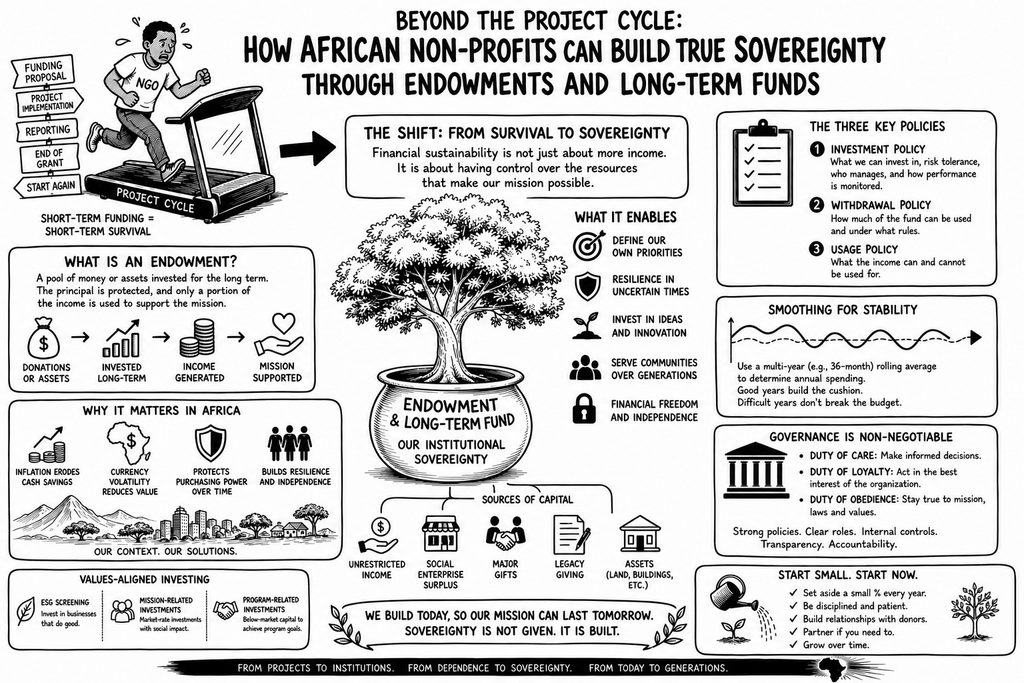
An organisation secures a three-year grant. It recruits staff, delivers the programme, produces reports, attends donor meetings and works hard to meet every target. As the grant approaches its end, the organisation starts looking for the next one.
Then the cycle begins again.
New proposal. New donor. New project. New reporting requirements. New uncertainty.
This is not because African organisations lack ideas, talent or commitment. It is because the funding system has trained us to think about survival in project cycles rather than building institutions that can survive across generations.
I have increasingly come to believe that financial sustainability is not simply about having more income. It is about having greater control over the resources that make our work possible.
That is what I mean by organisational sovereignty.
An organisation is more sovereign when it can make decisions based on its mission and the needs of the communities it serves not simply on what the next donor is willing to fund.
In my earlier article, The Five Income Streams African Non-Profits Must Have by 2036, I argued that African non-profits need to move beyond dependence on traditional grants. Diversifying across several donors is useful, but it is not enough if all those income streams remain controlled by external funders.
One of the most important pieces of this puzzle is therefore building long-term financial assets through endowments and investment funds.
This is not about becoming wealthy for the sake of being wealthy.
It is about building the financial foundation that allows African organisations to remain useful, independent and resilient.
The uncomfortable truth
Our sector is very good at financing activities.
We can raise money to train 500 young people.
We can raise money to support women entrepreneurs.
We can raise money to strengthen civil society organisations.
We can raise money for climate action, education, health and governance.
But we often struggle to raise money for the less visible things that make these programmes possible:
- strong leadership;
- staff development;
- technology;
- institutional systems;
- offices and facilities;
- knowledge management;
- reserves;
- organisational learning;
- financial systems; and
- long-term institutional development.
This creates a strange situation.
We expect organisations to deliver world-class programmes while giving them very little opportunity to build the institutional capital needed to do that work sustainably.
An organisation can therefore look successful from the outside while being financially vulnerable underneath.
I have seen this repeatedly across the African civil society sector.
A project may end. But the institution must continue.
That is the fundamental difference.
What is an endowment?
The word endowment can sound complicated and reserved for universities, large foundations or wealthy institutions.
It doesn’t have to be.
At its simplest, an endowment is money or assets that an organisation invests for the long term, with the intention of preserving the core capital while using part of the income generated to support its mission.
Imagine an organisation receives $1 million and places the capital into a professionally managed investment fund.
Rather than spending the $1 million immediately, the organisation protects the capital and uses a portion of the investment returns each year.
The capital becomes a long-term institutional asset.
Over time, that asset can help pay for things that donors may not always want to finance.
That is the power of an endowment.
It begins to change the question from:
“Who will fund us next year?”
to:
“How can we grow and protect our own institutional capital?”
That is a very different mindset.
This is particularly important in Africa
There is another reason why this conversation matters.
African organisations operate in economies where inflation and currency fluctuations can quickly reduce the real value of money.
A reserve sitting in a bank account may appear safe, but over time inflation can significantly reduce its purchasing power.
The situation becomes even more complicated when organisations receive funding in dollars or euros but operate mainly in local currencies.
Exchange-rate movements can dramatically change the value of resources available to an organisation.
This means that simply keeping money in the bank is not necessarily the same as building financial resilience.
We need to think about how institutional resources can be protected and, where appropriate, invested responsibly so that they retain and potentially increase their value over time.
Of course, this must be done carefully, with professional advice and in accordance with local laws.
But we should not avoid the conversation simply because investment feels unfamiliar.
Africa already has traditions of long-term giving
There is nothing particularly foreign about the idea of creating assets for social good.
Africa has long traditions of collective giving, community ownership and intergenerational responsibility.
One example is Waqf, an Islamic endowment structure through which assets such as land, buildings or financial resources can be dedicated to a social or charitable purpose, with income generated from those assets supporting communities over generations.
Across Africa, there are also community foundations, family foundations, trusts and other forms of collective philanthropy that demonstrate an important principle:
Giving does not always have to end when the donation is made.
The asset itself can continue producing social value.
This is something African civil society can learn from—and adapt to our own realities.
An endowment is not a savings account
This distinction is important.
A savings account is primarily designed to hold money safely and provide liquidity.
An endowment is designed for the long term.
It has a purpose, governance arrangements, investment rules and spending rules.
If an organisation wants to establish an endowment, I would recommend starting with at least three basic policies.
1. An Investment Policy
This should explain:
- what the organisation can invest in;
- what it cannot invest in;
- the level of risk it is prepared to accept;
- who manages the investments;
- how performance will be monitored; and
- how conflicts of interest will be managed.
The board should not be picking investments based on someone’s personal recommendation over lunch.
There needs to be a clear institutional process.
2. A Spending or Withdrawal Policy
The organisation must decide how much of the fund it can reasonably use each year.
The objective is to generate income without gradually destroying the capital.
For example, an organisation may establish a policy allowing a defined percentage of the fund’s value to support its operations annually.
The exact percentage should be determined based on the organisation’s circumstances, investment strategy and professional financial advice.
3. A Use Policy
The organisation should also be clear about what the income can support.
Can it finance core staff?
Can it support innovation?
Can it fund research?
Can it provide emergency organisational support?
Can it support the organisation’s unrestricted operations?
These decisions should be made before the money is needed.
Otherwise, pressure will eventually influence the decision.
The importance of “smoothing”
One challenge with investment income is that markets do not move in a straight line.
Some years will be good.
Some years will be difficult.
If an organisation simply spends whatever its investments earn each year, its budget can become unpredictable.
This is why many established institutions use a spending-rate and smoothing approach.
Instead of basing the annual allocation entirely on this year’s investment performance, the organisation can calculate its spending against an average value of the endowment over a defined period.
For example, a rolling multi-year average can help smooth out market highs and lows.
The benefit is significant.
Your organisation can plan with greater confidence.
Staff can be retained.
Programmes can continue.
And a difficult year in the financial markets does not immediately become a crisis for the organisation.
For African CSOs, this kind of predictability could be transformative.
But money without governance can become another problem
We should also be honest about the risks.
An endowment does not automatically create sustainability.
Poor governance can destroy it.
The larger the financial asset, the greater the responsibility of the board.
Boards need to understand their fiduciary responsibilities, including:
Duty of care
Board members need to make informed and responsible decisions. They cannot simply approve investment decisions without asking questions or seeking appropriate expertise.
Duty of loyalty
The organisation’s interests must come first.
Conflicts of interest must be declared and managed transparently.
Duty of obedience
The organisation must remain faithful to its mission, governing documents and applicable laws.
This is why I believe an Investment Policy Statement and strong internal controls are essential.
There should be clear approval thresholds, separation of responsibilities, proper documentation and regular independent review.
An endowment should strengthen institutional integrity, not create a new source of institutional risk.
Our money should not undermine our mission
There is another question we need to ask.
What are we investing in?
It makes little sense for a civil society organisation working on climate justice to invest its institutional capital in businesses that significantly contribute to environmental destruction.
Likewise, an organisation working on human rights should think carefully about whether its investments support companies whose practices contradict those values.
This is where values-aligned investing becomes important.
Depending on the organisation and its context, this could include:
- environmental, social and governance considerations;
- positive or negative investment screening;
- mission-related investments;
- programme-related investments; and
- investments in businesses that generate both financial and social value.
The principle is simple:
Our money should not work against the change we are trying to create.
We should not wait until we have millions
Perhaps the biggest misconception is that you need millions of dollars before you can start.
I disagree.
The most important thing is to start building the habit of accumulating institutional capital.
An organisation could decide, for example, that a small proportion of unrestricted income each year will be placed into a long-term fund.
It could start with $5,000.
Or $10,000.
Or $50,000.
The amount is less important than the discipline.
The organisation is saying:
“Not every dollar that comes into this organisation has to be spent today.”
That is a profound cultural shift.
Over ten or twenty years, those contributions can become meaningful institutional capital.
Where can the money come from?
There are several possibilities.
1. Unrestricted income
A percentage of unrestricted donations or earned income can be allocated annually.
2. Social enterprise income
Where an organisation has legitimate earned-income activities, a portion of the surplus could be reinvested into the endowment.
3. Major gifts
Some philanthropists may be interested in building something that lasts rather than simply financing another project.
We need to become better at making that proposition.
4. Legacy giving
African non-profits should begin thinking seriously about planned giving and legacy donations.
Someone may not be able to give $1 million today but may be willing to leave part of their estate to an organisation they believe in.
5. Assets
Endowments do not necessarily have to begin with cash.
Land, buildings and other assets can potentially become part of a long-term institutional investment strategy, subject to appropriate legal and financial structures.
This is particularly relevant for African organisations that own property but have not yet thought strategically about how those assets can generate sustainable income.
We also need to rethink our buildings
This is an area I believe deserves much more attention.
Across Africa, many CSOs own or have access to valuable land and buildings.
Yet we often think of these assets simply as offices.
What if we began asking different questions?
Could a conference facility generate income?
Could accommodation support organisational sustainability?
Could unused space be leased?
Could an organisation develop a training centre, social enterprise or knowledge hub?
Could part of the income generated from those assets be placed into a long-term institutional fund?
This is where asset ownership and endowment thinking can come together.
The objective is not to turn every NGO into a property company.
It is to recognise that institutional assets can become part of a broader sustainability strategy.
The African non-profit of the future will own things
This is perhaps the biggest shift I want us to consider.
For decades, we have measured organisational strength by the size of a grant portfolio.
Perhaps we should start measuring it differently.
How much unrestricted income does the organisation generate?
How many months of reserves does it have?
What assets does it own?
Does it have an investment fund?
Does it have intellectual property?
Does it have a strong brand?
Does it have a community of individual supporters?
Does it have relationships with African philanthropists?
Does it have systems that can survive the departure of its founder?
These are all indicators of institutional sovereignty.
The strongest African CSO of the future may not be the organisation with the biggest donor portfolio. It may be the one with the greatest ability to make decisions without constantly asking someone else to pay for them.
Sovereignty is built over time
I am not suggesting that African non-profits should suddenly stop seeking grants.
Grants will continue to play an important role.
The question is whether grants remain the foundation of our existence.
I would rather see grants become one part of a broader financial ecosystem that includes earned income, individual giving, philanthropy, partnerships, investments, assets and long-term funds.
That is the journey from dependency towards sovereignty.
It will not happen in one year.
It may take ten, fifteen or twenty years.
But we need to start.
Because if we continue financing African institutions primarily through short-term projects, we should not be surprised when those institutions remain vulnerable to short-term decisions made elsewhere.
The real question is not “How much can we raise?”
For me, the deeper question is:
How much institutional freedom can we build?
Can we create organisations that can say no to a funding opportunity that does not align with their mission?
Can we invest in an important idea before a donor calls for proposals?
Can we retain talented African professionals between projects?
Can we respond quickly when communities face a crisis?
Can we fund research because we believe it matters, not because a donor has already identified the topic?
Can we invest in the next generation of leaders?
That is what financial sovereignty makes possible.
It is time to move from fundraising to institution-building
Africa’s civil society sector is entering a difficult but potentially transformative period.
Traditional aid is under pressure. Donor priorities are changing. Competition for grants is increasing. Local organisations are being asked to do more with less.
But perhaps this crisis also gives us an opportunity to rethink the model.
We need to move from funding projects to financing institutions.
From consuming resources to building assets.
From annual survival to intergenerational thinking.
From donor dependence to diversified financial sovereignty.
And from asking only, “Who will fund our next project?” to asking:
“What can we build today that will continue financing our mission twenty years from now?”
That is the conversation I believe African non-profits need to have now.
Because sovereignty is not something that someone gives us.
We build it, one unrestricted dollar, one asset, one relationship and one long-term investment at a time.
And perhaps the most important investment we can make is not simply in our programmes.
It is in the financial foundations that allow our institutions to remain ours.