
Africa’s civil society sector is entering a different financial era.
For decades, many African civil society organisations (CSOs) have depended heavily on grants from international foundations, bilateral donors and development agencies. These grants have supported important work. They have funded education, health, human rights, governance, climate action, women’s rights and community development.
But the model is under pressure.
Funding is becoming more competitive. Grants are increasingly restricted. Core institutional costs are often difficult to finance. And many organisations are being asked to deliver more while having less control over the resources available to them.
This is why African non-profits need to think differently about income.
In my earlier article, “The Five Income Streams African Non-Profits Must Have by 2036“, I argued that African CSOs need to move from a grant-dependent model towards a more diversified financial architecture.
One of those emerging income streams deserves much more attention:
Climate finance and natural capital.
This is not simply about becoming an environmental organisation.
It is about recognising that Africa’s forests, wetlands, rivers, soils, biodiversity and landscapes have economic value and asking a fundamental question:
Who creates value from Africa’s natural capital, who controls it, and who gets paid for protecting it?
That question takes us beyond conservation.
It takes us into the territory of organisational sovereignty, community ownership and economic power.
Nature is not simply an environmental issue
For a long time, nature conservation was treated as a specialist area. Environmental organisations protected forests. Wildlife organisations protected animals. Communities protected wetlands. Governments created parks and conservation areas.
Meanwhile, the financial system largely treated nature as something that was simply there.
That is changing.
Forests store carbon. Wetlands regulate water and reduce flooding. Healthy soils support agriculture. Mangroves protect coastlines. Biodiversity supports food systems, tourism and pharmaceutical research.
These are economic services.
The problem is that much of this value has historically been invisible in economic decision-making.
The African Development Bank has increasingly highlighted the importance of valuing natural capital as part of Africa’s economic development. Its 2026 work notes that incorporating the value of carbon sequestration from African forests alone could have added an estimated US$66.1 billion to Africa’s measured GDP in 2022.
The message is simple:
What we fail to measure, we often fail to value. And what we fail to value, we struggle to finance.
This creates an opportunity for African CSOs.
But it also creates a warning.
If Africa’s natural capital becomes the next major global market and African organisations remain only project implementers, we will repeat the same mistake we have made with many other resources.
The objective should therefore not be simply to attract climate finance.
The objective should be to build African capacity to access, manage, influence and retain value from climate and nature finance.
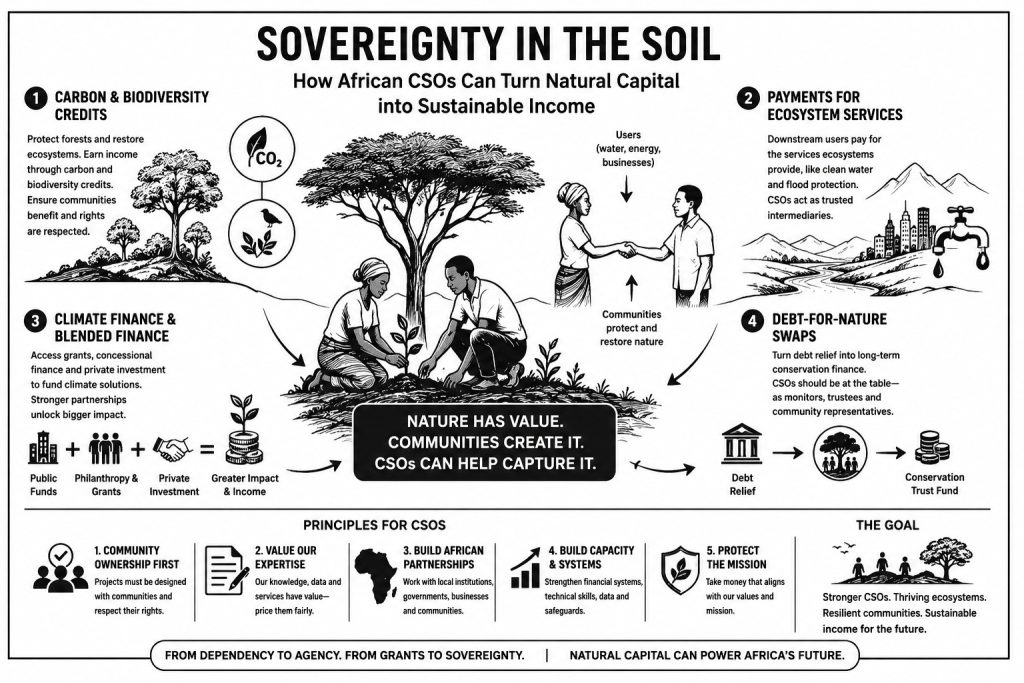
1. Carbon finance
One of the most obvious opportunities is carbon finance. Carbon markets can provide payments for activities that reduce or remove greenhouse gas emissions. These can include forest protection, reforestation, agroforestry, improved land management, mangrove restoration and other activities.
The Paris Agreement’s Article 6 provides frameworks for international cooperation on climate action, including mechanisms for internationally transferred mitigation outcomes and a UN mechanism for carbon credits.
Africa is therefore entering a growing market.
But African CSOs should approach carbon markets carefully.
A CSO working with farming communities, for example, could help develop an agroforestry programme that combines climate resilience, improved livelihoods and carbon benefits.
The organisation could potentially earn income through:
- project development;
- technical assistance;
- community mobilisation;
- monitoring and verification;
- programme management;
- training;
- data collection;
- brokerage and partnership management.
But the financial model must be transparent.
Communities should understand what is being sold, who owns the underlying rights, who receives the income and what happens if the value of the credits changes.
The CSO should not simply become another intermediary taking a large share of the value.
The principle should be value creation with value sharing.
2. Biodiversity finance
Carbon is only part of the opportunity. A second market is emerging around biodiversity and nature.
The idea is relatively simple, if carbon markets place financial value on emissions reductions or removals, biodiversity-related finance seeks ways of directing money towards the protection and restoration of ecosystems and biodiversity.
This is particularly relevant to Africa. The continent contains some of the world’s most important forests, wetlands, savannahs, marine ecosystems and wildlife habitats. Yet the communities living alongside these ecosystems often remain among the poorest.
This creates an uncomfortable contradiction:
The world increasingly values African biodiversity, but the people who protect it often capture very little of that value.
CSOs can help change this.
They can become:
- community organisers;
- biodiversity monitoring partners;
- ecosystem restoration managers;
- data and evidence providers;
- independent verification partners;
- community rights advocates;
- benefit-sharing facilitators;
- project developers.
The opportunity is not simply to create another financial product.
It is to create a fairer relationship between nature, markets and communities.
This is particularly important because biodiversity markets are still developing. Standards, methodologies and safeguards are evolving.
CSOs should therefore avoid rushing into every new biodiversity-credit opportunity.
They should ask:
Who owns the biodiversity data?
Who owns the project?
Who receives the revenue?
What rights do communities have?
What happens when the project ends?
And perhaps most importantly:
Does the financing improve conservation and livelihoods, or does it simply create another mechanism for extracting value from Africa?
3. Payments for Ecosystem Services
There is another opportunity that may be particularly relevant for African CSOs, Payments for Ecosystem Services (PES).
The idea is straightforward.
One group protects or manages an ecosystem.
Another group benefits from the service that ecosystem provides.
The beneficiary pays for that service.
For example, communities upstream may protect forests and watersheds that help maintain water quality downstream.
Instead of relying entirely on a short-term conservation grant, a PES model creates a longer-term relationship between those who benefit from the ecosystem and those who protect it.
This is not theoretical.
In Ghana, work on natural capital accounting has already helped inform a feasibility study for PES, including identifying commercial water suppliers and users that could potentially participate in water-related ecosystem-service arrangements.
This creates an interesting role for CSOs.
A CSO could act as the trusted intermediary between communities and service users.
It could help:
- identify the ecosystem service;
- organise communities;
- establish the baseline;
- measure environmental outcomes;
- negotiate agreements;
- manage payments;
- monitor compliance;
- report results.
The organisation could charge a reasonable management or technical fee for providing these services.
This creates something different from a grant.
Instead of saying:
“Please give us money so that we can protect this watershed.”
The conversation becomes:
“Your business depends on this watershed. We can help organise the communities and systems needed to protect it. What are you prepared to invest in maintaining the service on which your business depends?”
That is a fundamentally different financial relationship.
4. Climate finance is much bigger than carbon
CSOs should also avoid thinking that climate finance equals carbon credits. It does not.
There are major pools of climate finance supporting adaptation, resilience, agriculture, water, energy, cities, infrastructure and ecosystem restoration.
The Green Climate Fund (GCF), for example, supports country-driven climate action through readiness support, project preparation and implementation finance. Organisations can participate through accredited entities, project-specific arrangements and other partnerships.
The GCF currently recognises non-governmental organisations as potential accredited entities, provided they meet the required fiduciary, environmental and social safeguards and other standards.
This creates several routes for CSOs.
Route 1: Become a direct access organisation
Larger, more established CSOs with strong financial, governance and safeguarding systems could consider accreditation.
This is not for everyone.
Accreditation requires significant institutional capacity. But it is worth considering for organisations that already have the scale and systems required.
Route 2: Partner with an accredited organisation
For many CSOs, this is likely to be more realistic.
An organisation can develop a strong project concept and partner with a GCF-accredited institution that can access the finance.
The CSO can then earn legitimate income for project development, implementation, technical expertise, monitoring, community engagement or programme management.
Route 3: Become a specialist climate-finance service provider
This may be an overlooked opportunity.
Many governments, financial institutions and development partners need organisations that understand communities and can help translate climate investments into practical action.
CSOs can develop expertise in:
- climate vulnerability assessments;
- community engagement;
- adaptation planning;
- project development;
- safeguards;
- gender and inclusion;
- monitoring and learning;
- climate communications;
- locally led adaptation.
The GCF’s readiness programme itself places emphasis on strengthening institutional capacity, climate investment planning and the ability to develop investment-ready pipelines.
In other words, climate finance creates demand not only for projects, but for capabilities.
That is where African CSOs can position themselves.
5. Debt-for-nature swaps
A further opportunity is debt-for-nature finance. In simple terms, a debt-for-nature swap can restructure part of a country’s debt in exchange for commitments to invest in conservation or environmental outcomes.
Recent transactions in countries including Gabon have demonstrated the potential of this model in Africa, although such arrangements also raise important questions about cost, governance, transparency and oversight.
This is where African civil society needs to become much more sophisticated.
CSOs should not wait until a debt-for-nature transaction has been negotiated and then be invited to a workshop to “validate” it.
They should be involved much earlier.
They should ask:
- What conservation commitments are being made?
- Who designed them?
- Where will the money go?
- Who will manage the funds?
- How will communities benefit?
- What safeguards exist?
- Who independently monitors the agreement?
- What happens if governments or investors fail to deliver?
There is a potential role for independent African civil society as watchdogs, trustees, community representatives, monitors and knowledge partners.
This is important because large financial transactions can create significant risks if transparency and accountability are weak.
Debt-for-nature finance should therefore not become another area where sophisticated international actors manage billions while local organisations receive small implementation grants.
African CSOs should be part of the governance architecture.
6. Natural capital can become an organisational asset
There is an even bigger idea here. CSOs should stop thinking only about the natural resources they protect.
They should think about the knowledge, relationships and infrastructure they have built around those resources.
Consider an organisation that has spent 15 years working with farming communities.
It may possess:
- detailed local ecological knowledge;
- community relationships;
- land-use information;
- restoration experience;
- climate data;
- trained community monitors;
- farmer networks;
- relationships with traditional authorities;
- knowledge of local institutions.
That is an organisational asset.
Yet organisations often give this knowledge away for free through donor-funded projects.
The future may require a different approach.
CSOs should ask:
What knowledge do we own?
What data have we generated?
What methodologies have we developed?
What services can we provide?
What expertise could others legitimately pay for?
This does not mean commercialising everything.
It means understanding the economic value of organisational knowledge while protecting community rights and the public interest.
7. But there is a major danger
There is a serious warning behind all of this. Climate finance can reproduce the same power imbalances that have existed in traditional development finance.
A foreign company may come into a community with a carbon project.
A consultant may develop the project.
An international verifier may certify it.
A foreign buyer may purchase the credits.
A financial institution may structure the transaction.
And the local CSO may receive a small implementation contract.
The language may be about climate action and conservation.
But the power structure may look remarkably familiar.
The money is global. The expertise is international. The decisions are external. The community supplies the land.
That is not a climate-finance revolution.
It is simply a new form of extraction.
African CSOs therefore need a power lens, not just a funding lens.
The question is not only:
“How much money can this project raise?”
It is also:
“Who will control the money, the data, the land, the decisions and the benefits?”
8. Five principles for African CSOs entering climate finance
I would suggest five principles.
1. Community ownership first
Do not build climate-finance projects around communities.
Build them with communities.
Clarify rights, responsibilities and benefit-sharing from the beginning.
2. Do not give away your expertise for free
If your organisation provides technical expertise, data, monitoring, community mobilisation or programme management, build those capabilities into the financial model.
3. Build African partnerships
CSOs should work with African universities, financial institutions, technology companies, governments and other civil society organisations.
No organisation will master this field alone.
4. Build financial and technical capability
Climate finance requires more than passion.
Organisations need expertise in financial management, contracts, carbon accounting, environmental safeguards, data, monitoring and investment.
5. Protect the mission
Not every source of climate finance is a good source of finance.
An organisation should be prepared to walk away from money if the terms undermine community rights, environmental integrity or its mission.
Financial sustainability without mission integrity is not organisational sovereignty.
9. A practical 2026–2036 roadmap
If African CSOs are serious about making climate finance and natural capital an income stream by 2036, they should start now.
2026–2028: Build knowledge
Every organisation does not need to become a carbon-market expert.
But every organisation should understand:
- climate finance;
- natural capital;
- carbon markets;
- biodiversity finance;
- PES;
- blended finance;
- climate funds;
- Article 6;
- environmental safeguards.
Organisations should also map the natural assets and climate challenges connected to their work.
2028–2030: Develop pilot projects
Identify one or two areas where the organisation already has credibility.
For example:
- watershed protection;
- agroforestry;
- mangrove restoration;
- sustainable agriculture;
- forest protection;
- community conservation;
- climate-resilient livelihoods.
Then develop small, credible pilots.
The goal should be to learn before scaling.
2030–2033: Build revenue models
Move beyond project grants.
Develop income through:
- technical services;
- project development;
- monitoring and verification;
- management fees;
- PES arrangements;
- climate-finance partnerships;
- carbon and biodiversity projects where appropriate;
- training and advisory services.
2033–2036: Build institutional assets
The ultimate objective should be to create organisations that have:
- unrestricted income;
- specialist climate expertise;
- strong data systems;
- intellectual property;
- long-term community partnerships;
- investment relationships;
- credible financial systems;
- diversified revenue.
At that point, climate and natural capital finance becomes part of the organisation’s financial architecture rather than another temporary project.
The bigger opportunity
There is a deeper reason why this conversation matters. Africa is entering a period in which the world’s demand for its natural assets is likely to increase.
The global energy transition needs minerals.
The climate crisis increases the value of carbon sinks.
Food insecurity increases the importance of healthy soils and water systems.
Biodiversity loss increases the value of ecosystems.
This means Africa’s natural capital will become increasingly important to the global economy.
The question is therefore not whether Africa’s natural capital will be valued.
It will.
The real question is:
Who will capture that value?
The African Development Bank’s recent work on natural capital makes precisely this broader point: valuing Africa’s natural wealth can help expand economic and financial opportunities while supporting more sustainable development.
African CSOs should therefore see climate finance as more than another funding opportunity.
It is an opportunity to rethink the relationship between nature, money, communities and power.
The 2036 test
By 2036, I would like us to be able to look back and say that African civil society did not simply become better at writing climate proposals.
We became better at owning the systems around climate finance.
We built African expertise.
We built African institutions.
We built community-owned models.
We developed new income streams.
We helped communities capture more value from the resources they protect.
And we ensured that the global transition to a green economy did not simply create another extractive relationship with Africa.
This is the real connection between climate finance and organisational sovereignty.
Natural capital is not simply something African CSOs should protect.
It is something we need to understand, value, govern and help communities benefit from.
The future of African civil society cannot depend entirely on asking someone else to fund the work we believe matters.
We need to build organisations that can mobilise resources from multiple sources while remaining accountable to their missions and the communities they serve.
The next decade therefore requires a different question.
Not:
“Who will fund our conservation work?”
But:
“How can the value created by our land, knowledge, relationships and conservation work help finance the institutions and communities that protect them?”
That is the shift from dependency to agency.
And it may be one of the most important financial shifts African civil society can make before 2036.