
When was the last time your organisation’s strategy genuinely changed the way you make decisions?
For many organisations, strategy becomes a conversation that happens every three to five years.
A consultant is brought in. Staff and board members attend workshops. Stakeholders are interviewed. A new strategic plan is produced, presented to the board — and then, quite often, everyone returns to business as usual.
The problem is not necessarily the plan.
The problem is when we treat strategy as a document rather than a way of leading.
Strategy is about choices: what matters most, where to focus scarce resources, what to stop doing, how to respond to change and what kind of impact we want to create.
For an Executive Director, therefore, strategy should show up in everyday conversations — leadership meetings, board discussions, programme reviews, budget decisions and conversations with communities.
The strongest leaders are not necessarily those who have all the answers.
They are often the ones who know which questions the organisation needs to confront.
Here are 12 questions worth keeping on the leadership table.
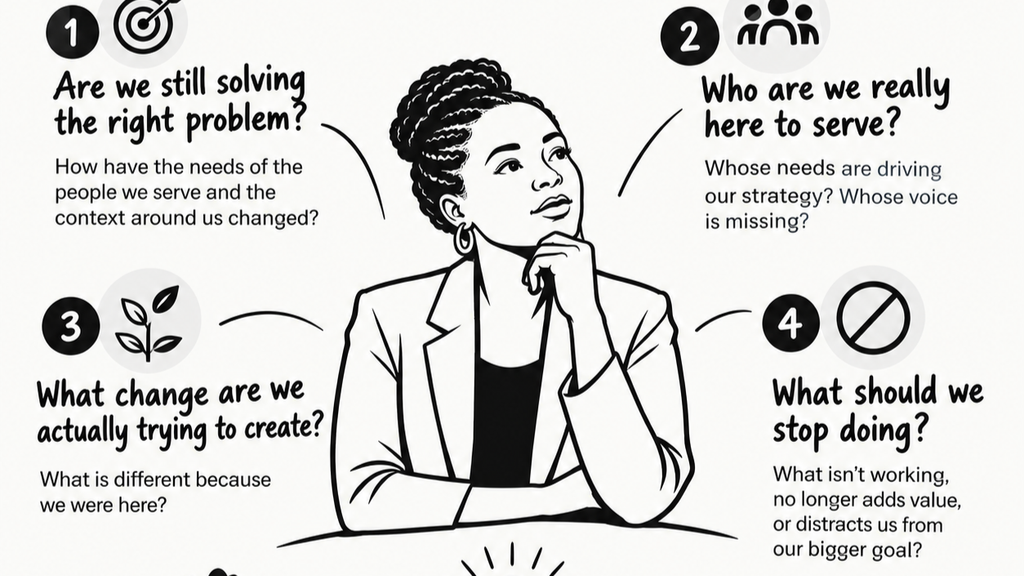
1. Are we still solving the right problem?
Organisations can become very good at delivering solutions to problems that have changed.
The needs of communities evolve. Technology changes. Policies shift. New challenges emerge.
So ask:
What has changed in the lives of the people we serve?
What has changed in the wider environment?
Are we still addressing the problem that matters most?
Success in delivering yesterday’s solution does not necessarily mean we are solving today’s problem.
2. Who are we really here to serve?
Over time, organisations can become accountable to many different groups — donors, boards, government, partners, staff and communities.
Sometimes their priorities align. Sometimes they do not.
So ask:
Whose needs are driving our strategy?
Whose voice is missing?
Who actually influences our decisions?
And perhaps most importantly:
Would the people we exist to serve recognise themselves in our strategy?
Consultation is useful. But meaningful strategy requires more than asking people what they think. It requires creating space for their perspectives to influence decisions.
3. What change are we actually trying to create?
Many organisations can explain what they do.
We run training.
We distribute grants.
We build schools.
We support entrepreneurs.
We conduct research.
We advocate for policy change.
But activity is not the same as impact.
An organisation might train 5,000 young people. But what changed?
Did they find employment?
Did their incomes increase?
Did their confidence improve?
Did the wider system change?
The more useful question is:
What is different because we were here?
That is a harder question — but it is also a more important one.
4. What should we stop doing?
This may be one of the hardest questions for leaders.
Organisations often find it easier to add programmes than to remove them.
A new donor arrives. A new project starts. A new opportunity emerges. An old programme continues because, well, “we have always done it.”
Eventually, the organisation is doing too much with too few resources.
Ask:
If we had to reduce our work by 20%, what would we stop?
Which programmes create the greatest value?
What consumes significant resources but produces limited impact?
What are we doing because it fits our mission — and what are we doing simply because funding is available?
Sometimes, one of the most strategic things a leader can do is say no.
5. Are we following the money — or is the money following the strategy?
This is where strategy meets financial sustainability.
Many organisations have clear strategic priorities on paper but allow funding opportunities to determine what they actually do.
A large grant arrives for something outside the organisation’s core direction.
Do we change our strategy to accommodate the funding?
Or do we ask whether the funding supports the strategy we already have?
Of course, organisations need resources to survive.
But repeatedly changing direction to follow funding can gradually erode organisational identity.
Ask:
Does our budget reflect our strategy?
Are we investing in the capabilities we say matter?
How financially vulnerable are we?
Are we building unrestricted resources and reserves?
A strategy without resources is an aspiration.
A budget without strategy is simply a spending plan.
6. What is our unique contribution?
Ask yourself:
Why us?
Not because your organisation needs to prove it is better than everyone else.
But because resources are limited and duplication is common.
If five organisations are working on youth employment in the same region, does your organisation need to deliver another training programme?
Perhaps your greatest contribution is to convene others, generate evidence, influence policy or strengthen smaller community organisations.
Impact does not always come from doing more.
Sometimes it comes from playing the right role in the wider system.
7. Are we listening to the people closest to the problem?
There is an important difference between consulting communities and sharing decision-making power with them.
An organisation can conduct surveys, hold community meetings and gather feedback — while still making all the important decisions internally.
So ask:
Who defines the problem?
Who determines the priorities?
Who controls the resources?
Who decides whether the intervention has worked?
If communities are expected to own solutions, they need more than a voice.
They need meaningful influence.
8. What assumptions are we making?
Every strategy contains assumptions.
We assume funding will continue.
We assume a particular intervention will produce a particular outcome.
We assume communities will respond in a certain way.
We assume government policy will remain supportive.
We assume technology will behave as expected.
The danger is that assumptions can become invisible.
Leadership means making them visible again.
Ask:
What must be true for our strategy to work?
Which assumptions are we least certain about?
What evidence do we have?
What would cause us to change course?
This creates a culture of learning rather than one where teams defend plans simply because they have already been approved.
9. Are we governing for the future — or managing the present?
Boards and Executive Directors have important operational responsibilities.
But governance also requires foresight.
Ask:
What happens if our largest funder leaves?
What does AI mean for our organisation?
What if community needs change?
What happens if civic space becomes more restricted?
What capabilities will we need in three years that we do not have today?
The future rarely arrives with a warning.
Strategic leadership means creating the space to think about it before it arrives.
10. Do we have the organisation needed to deliver the strategy?
Sometimes the strategy is not the problem.
The organisation simply does not yet have the capabilities to deliver it.
You cannot pursue a digital strategy without digital capability.
You cannot pursue locally led development without changing how decisions and resources flow.
You cannot scale programmes without appropriate systems, leadership and financial capacity.
So ask:
What capabilities does our strategy require?
Do we have the right people?
Do we have the right systems?
Do we have the right leadership?
What needs to change internally for the strategy to become reality?
Strategy and organisational development cannot be separated.
11. What happens if I am no longer the Executive Director?
This may be the most uncomfortable question of all.
If the organisation cannot function effectively without its Executive Director, that may indicate organisational dependency rather than strong leadership.
Ask:
Are we developing leaders beyond the Executive Director?
Are key relationships institutional or personal?
Can others make important decisions without me?
Do we have an emergency succession plan?
Do we have a longer-term leadership succession approach?
Good leadership should create more leadership.
12. What would happen if we were brave enough to change the strategy?
Sometimes organisations already know.
They know a programme is no longer working.
They know a funding model is unsustainable.
They know communities want something different.
They know their organisational structure is no longer fit for purpose.
But changing direction can be frightening.
There are jobs, funder relationships, institutional history and reputational considerations involved.
Strategic leadership therefore requires courage.
Not reckless change.
Not change for the sake of change.
But the willingness to acknowledge when reality has moved on.
Strategy Should Create Better Decisions — Not a Thicker Document
Perhaps this is the biggest lesson.
A strategic plan should not become a document that sits on a shelf.
It should improve the quality of everyday decisions.
When a new funding opportunity arrives, strategy should help you decide whether to pursue it.
When a new programme is proposed, it should help you ask whether it advances the mission.
When resources become scarce, it should help determine what gets protected.
When the external environment changes, it should help the organisation adapt.
And when something is not working, it should create permission to learn and change.
So perhaps the most important question for an Executive Director is not:
“Do we have a strategic plan?”
It is:
“Are we making the strategic choices necessary to remain relevant to the people and communities we exist to serve?”
And there is one final question I would leave with every leadership team:
If we continue doing what we are doing today for the next five years, will we still be the organisation our communities need?
If the answer is uncertain, that is not necessarily a problem.
It may simply be the beginning of the most important strategic conversation your organisation needs to have.
A question for you
Which of these questions does your organisation most need to confront right now?