
This article is a continuation of “The Five Income Streams African Non-Profits Must Have by 2036”.
For many African non-profits, the question is no longer whether they should diversify their income. The question is how.
For decades, grants have been the main source of income for many civil society organisations. Grants have made important work possible. They have supported communities, strengthened institutions and helped organisations respond to some of Africa’s most pressing challenges.
But grants come with a problem: they are not fully within the organisation’s control.
A donor can change its priorities. A funding programme can end. A grant can be delayed. A country strategy can change. An organisation can be doing excellent work and still find itself struggling to pay staff or keep the lights on.
This is why earned income and social enterprise deserve much more attention.
The goal is not to turn African non-profits into businesses.
The goal is to help them build organisations that can generate part of the income they need to survive, grow and pursue their mission with greater freedom.
The Grant Dependency Problem
Many non-profits have become very good at writing proposals.
They identify a funding opportunity, develop a concept note, prepare a budget, submit an application and wait.
If successful, they implement the project.
Then the cycle starts again.
This model can work when funding is available. But it creates a difficult relationship with money.
The organisation becomes dependent on someone else deciding:
- What is important;
- What should be funded;
- How much money is available;
- How long the funding will last; and
- What the organisation is allowed to spend it on.
This can gradually affect organisational behaviour.
Instead of asking, “What does our mission require?”, organisations can start asking, “What will donors fund?”
That is a dangerous shift.
Earned income provides an opportunity to begin reversing it.
What Does Earned Income Actually Mean?
Earned income is simply money an organisation generates by providing something that people or institutions are willing to pay for.
It could be a service.
It could be a product.
It could be training.
It could be research.
It could be a membership.
It could be the use of an organisational asset.
The important point is that the income comes from an exchange of value rather than a grant.
For example, an organisation with strong expertise in governance could provide governance training to companies, foundations and other NGOs.
An organisation with research capacity could provide research and evaluation services.
An organisation with a training centre could rent its facilities when they are not being used.
An organisation with strong intellectual property could develop courses, publications, toolkits or certification programmes.
The possibilities are much wider than many organisations realise.
African Non-Profits Have Assets They Are Not Monetising
One of the biggest opportunities is sitting inside African non-profits already.
It is their knowledge.
Over many years, organisations have developed expertise in areas such as:
- Community development;
- Gender equality;
- Youth leadership;
- Governance;
- Climate change;
- Disability inclusion;
- Organisational development;
- Fundraising;
- Monitoring and evaluation;
- Research;
- Policy advocacy; and
- Training.
Yet much of this knowledge is treated simply as part of a grant-funded project.
What if some of that knowledge could become an income-generating service?
An organisation does not have to sell its mission.
It can create value from the expertise it has developed while remaining faithful to its mission.
Five Earned-Income Opportunities
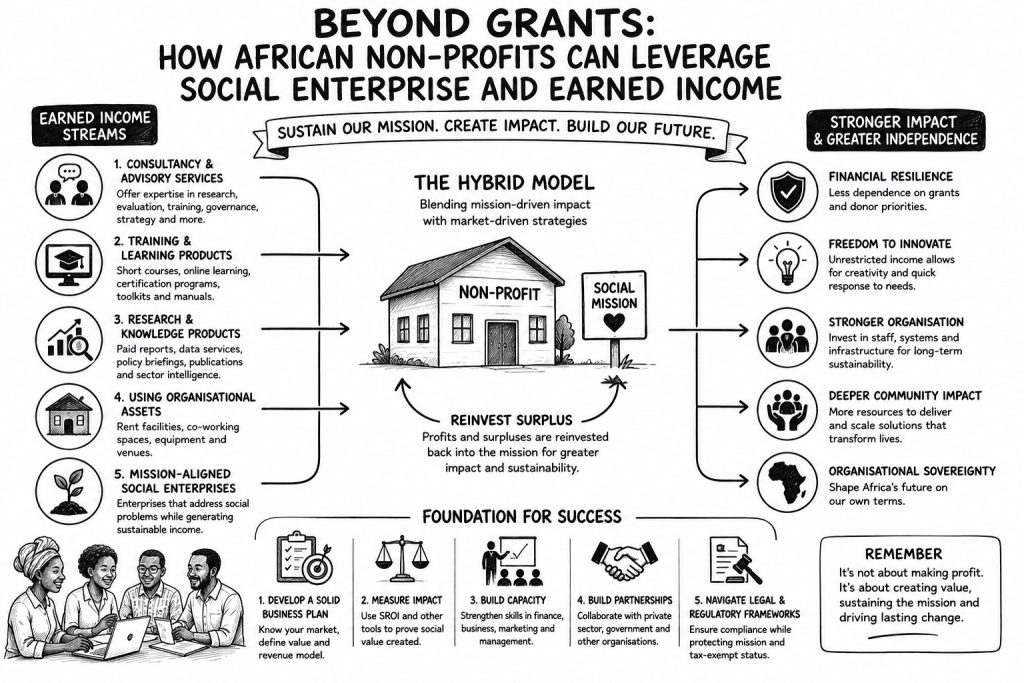
1. Consultancy and Advisory Services
This is perhaps the easiest place for many established non-profits to start.
If your organisation has expertise that others need, there is potential to provide it as a paid service.
This could include:
- Organisational assessments;
- Strategic planning;
- Governance support;
- Research;
- Evaluations;
- Training;
- Facilitation;
- Fundraising advisory services;
- Policy analysis; and
- Leadership development.
The key is to identify what your organisation does particularly well and determine whether there is a market willing to pay for it.
2. Training and Learning Products
Training can become a significant income stream.
Instead of delivering every programme only through grants, organisations can develop paid learning products.
For example:
- Short professional courses;
- Online programmes;
- Leadership academies;
- Certification programmes;
- Masterclasses;
- Training manuals;
- Toolkits; and
- Executive learning programmes.
This has another advantage.
Once a good course has been developed, it can potentially be delivered many times without starting from zero each time.
The organisation’s knowledge becomes an asset.
3. Research and Knowledge Products
African organisations produce enormous amounts of valuable knowledge.
But too often, research is produced because a donor has paid for it and then sits on a website with very little further use.
Organisations can think differently about their intellectual assets.
They could develop:
- Paid research reports;
- Subscription-based knowledge services;
- Data products;
- Policy briefings;
- Sector intelligence;
- Research databases; and
- Specialised publications.
The question should be:
What knowledge do we have that other people need and would pay to access?
4. Using Organisational Assets
Sometimes the opportunity is not in what the organisation knows but in what it owns or has access to.
A training centre could generate income by renting space.
An office could provide co-working facilities.
A conference facility could host external events.
Equipment could be rented when not in use.
Technology platforms could be made available to other organisations.
This is particularly relevant for organisations that have invested in infrastructure but use it only for part of the year.
The principle is simple:
If an asset is sitting idle, ask whether it can generate income without undermining the mission.
5. Mission-Aligned Social Enterprises
This is the more ambitious option.
A non-profit can establish or invest in an enterprise that directly supports its mission.
For example, an organisation working with young people could create a business that provides employment and skills development.
An organisation working in agriculture could develop a social enterprise that connects smallholder farmers to markets.
An environmental organisation could develop an enterprise around recycling, sustainable agriculture or renewable energy.
The critical test is mission alignment.
The enterprise should not exist simply because it makes money.
It should contribute to the change the organisation exists to achieve.
Do Not Start With the Business. Start With the Problem.
One mistake organisations can make is jumping into business simply because they are worried about funding.
That is unlikely to work.
The starting point should be:
What problem can we solve better than others?
Then ask:
Who experiences this problem, and who is willing to pay for a solution?
This requires organisations to understand their market.
A product that nobody wants to buy is not an earned-income strategy.
Good intentions are not enough.
There must be genuine value.
The Mindset Shift
Moving into earned income requires a significant change in organisational thinking.
Non-profits are accustomed to asking:
“What activities can we fund?”
A social enterprise mindset asks:
“What value can we create?”
This is a powerful shift.
It also means recognising that the organisation has more than a social mission.
It has assets.
These might include:
- People;
- Knowledge;
- Networks;
- Data;
- Intellectual property;
- Reputation;
- Relationships;
- Infrastructure; and
- Community trust.
The challenge is to understand how these assets can create sustainable value.
Do Not Confuse Revenue With Impact
There is also a danger here.
An organisation can become so focused on making money that it slowly loses sight of why it exists.
That is why the mission must remain the anchor.
Before launching an income-generating activity, organisations should ask three questions:
Does it generate value?
Does it generate income?
Does it strengthen our mission?
If the answer to the third question is no, the organisation should think carefully before proceeding.
Build a Separate Commercial Function
Earned income should not simply be added to someone’s already full job description.
If the organisation is serious about this approach, it needs to develop some basic commercial capabilities.
This includes:
- Understanding customers;
- Pricing services;
- Marketing;
- Sales;
- Financial management;
- Contract management;
- Business development; and
- Customer service.
This does not mean becoming a corporate organisation.
It means recognising that earning income requires a different set of skills from managing a grant.
Start Small
Non-profits do not need to create a multimillion-dollar social enterprise overnight.
Start with one opportunity.
For example, an organisation might identify a training course that is currently delivered through donor funding.
Test whether organisations would pay for it.
Develop a simple offer.
Set a price.
Find five customers.
Learn from the experience.
Then improve.
Earned income should be treated as an experiment before it becomes a major part of the business model.
The Importance of Unrestricted Income
One of the biggest advantages of earned income is that it can provide greater flexibility.
Donor funding is often tied to specific activities.
Earned income can provide money that the organisation can use to strengthen its operations, invest in people, develop new ideas or respond to emerging needs.
This is particularly important for organisational sovereignty.
An organisation that has some income it controls has more room to make decisions based on its mission rather than constantly adjusting itself to external funding priorities.
But Earned Income Is Not a Magic Solution
We should also be realistic.
Not every organisation should become a social enterprise.
Some missions do not have obvious markets.
Some communities cannot afford to pay for the services they need.
Some activities will always require philanthropic support.
The answer is therefore not to replace grants with earned income.
It is to create a healthier mix.
A resilient organisation of the future may combine:
Grants + earned income + philanthropy + memberships + investments + partnerships.
The objective is diversification.
The 2036 Question
By 2036, I believe one of the defining questions for African non-profits will be:
How much of our organisation’s future can we control ourselves?
Financial resilience is not simply about having more money.
It is about having more choices.
When an organisation has multiple income streams, it can make decisions with greater confidence.
It can invest in its people.
It can retain institutional knowledge.
It can respond to opportunities.
It can survive funding shocks.
And most importantly, it can protect its mission.
From Funding Recipients to Value Creators
The future African non-profit should not be defined only by its ability to attract grants.
It should also be recognised for its ability to create value, generate income and mobilise resources around its mission.
This does not mean abandoning philanthropy.
It means becoming less dependent on any single source of money.
The real opportunity is to build organisations that can combine the best of both worlds: the mission and purpose of a non-profit with the innovation, discipline and income-generating capacity of an enterprise.
That is not the end of the non-profit.
It may be the beginning of a more sovereign one.
The Question for African Non-Profits
So, perhaps the question we should be asking is not:
“Which donor will fund us next?”
But:
“What value do we have, what problems can we solve, and how can we generate some of the resources needed to sustain our mission?”
That is the conversation African civil society needs to start having now, not in 2036.
Because organisational sustainability is not something we should wait to achieve.
We need to start building it.