
In my earlier article, “The Five Income Streams African Non-Profits Must Have by 2036”, I argued that African civil society organisations cannot continue to build their futures around a single dominant source of income.
For many organisations, that dominant source has been international grants.
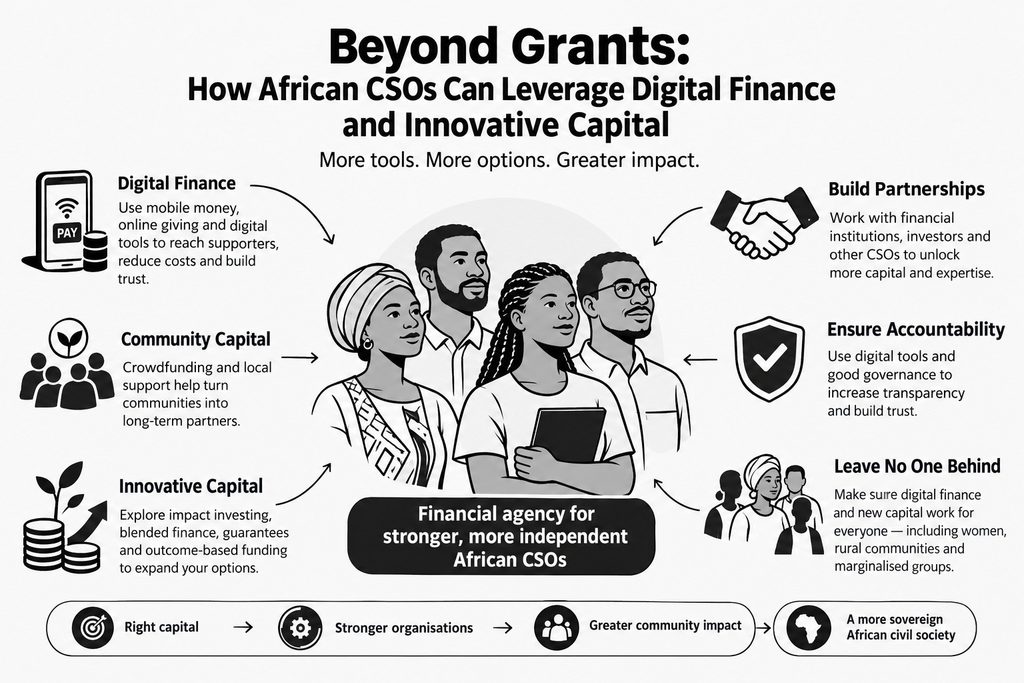
Grants will remain important. But they cannot be the only engine keeping an organisation alive.
Funding priorities change. Governments reduce aid budgets. Foundations change their strategies. Economic crises affect philanthropy. And when a major donor leaves, organisations that have built their entire operating model around that donor can suddenly find themselves in survival mode.
This is why financial sustainability is not simply about raising more money.
It is about building greater financial agency.
And one of the most exciting opportunities ahead is the combination of digital finance and innovative capital.
Africa does not have to wait for the future of finance. In many ways, that future is already here.
Africa is already a digital finance continent
Consider mobile money.
In 2025, mobile money transactions globally exceeded US$2 trillion, with 2.3 billion registered accounts. Sub-Saharan Africa remains at the centre of this growth.
GSMA estimates that mobile money transactions in Sub-Saharan Africa were worth about US$1.1 trillion in 2024, representing almost 65% of global transaction value.
This matters for CSOs.
The same digital infrastructure that allows someone to send money to a family member can also allow a supporter to give to a local organisation.
The same platforms that enable small businesses to receive payments can help community enterprises participating in conservation, agriculture or women’s economic empowerment programmes.
The same digital systems that make it easier to move money can help CSOs reduce transaction costs, reach supporters directly and build stronger financial relationships.
So the question is no longer whether African CSOs should engage with digital finance.
The question is, how can we use it strategically without compromising our values, accountability or mission?
1. Turn digital giving into a relationship, not just a transaction
For many CSOs, digital fundraising still means posting a bank account number or mobile money number when there is an emergency.
That is not a digital fundraising strategy.
A stronger approach is to build a digital giving relationship.
Imagine a small Ghanaian organisation with 500 supporters across Ghana and the diaspora.
Instead of asking them for a large donation once a year, the organisation could invite them to become monthly supporters:
- GHS 20 a month to support community education;
- GHS 50 to support a young person’s skills training;
- GHS 100 to support a community organiser;
- GHS 200 to support a local environmental initiative.
The amounts may be small.
But 500 people giving regularly can create a more predictable income stream than waiting for one large grant.
Digital platforms can make this possible through mobile money, bank transfers, payment links, online fundraising platforms and other emerging tools.
The real opportunity, however, is not the technology.
It is the relationship.
People are more likely to continue giving when they understand what their contribution is supporting and can see the difference it makes.
2. Build a community of small investors in your mission
Crowdfunding offers another opportunity.
But African CSOs should think beyond crowdfunding as an emergency fundraising tool.
It can become a way of building community ownership.
A CSO could raise money for a community library, solar-powered learning centre, women’s cooperative, youth enterprise or environmental restoration initiative from hundreds or thousands of people.
The important shift is from, “please fund our project” to “come and invest in this solution with us.”
This does not necessarily mean that contributors receive a financial return. The return may be social, environmental or community-based.
What matters is that the organisation begins to develop a wider circle of people who have a stake in its work.
That can include local citizens, diaspora communities, alumni, social entrepreneurs, businesses and philanthropic supporters.
3. Stop thinking of capital as only grants
One of the biggest shifts African CSOs need to make is to stop putting every funding opportunity into the category of “grant”.
There are different forms of capital.
There are grants.
There are recoverable grants.
There are patient loans.
There are guarantees.
There is equity.
There is impact investment.
There is blended finance.
There is results-based financing.
Not every CSO should use all of these.
But understanding the different forms of capital can dramatically expand an organisation’s options.
Think of it as a capital ladder, Grant → Recoverable Grant → Concessional Finance → Impact Investment → Commercial Finance.
The further along the ladder you go, the greater the expectation of repayment or financial return.
The lesson is not that every non-profit should become an investment company.
It is that different problems require different types of capital.
4. Use grants to unlock other forms of capital
This is where blended finance becomes interesting.
A grant does not always have to pay for the whole solution.
Sometimes a relatively small amount of philanthropic or concessional funding can reduce risk and make it possible for other investors to participate.
For example, imagine a CSO working with women farmers.
A grant could finance training, business support and market development.
Once the model demonstrates that farmers can generate reliable income, a financial institution may be more willing to provide working capital.
The grant has therefore done something more than fund a project.
It has helped unlock capital.
This is an important shift in thinking.
Instead of asking, “how much grant money do we need?” CSOs could increasingly ask, “what is the right mix of capital required to solve this problem?”
5. Become a bridge between capital and communities
Many community organisations are not ready to receive commercial investment.
That does not mean there is no investment opportunity.
It may mean they need someone to help build the bridge.
CSOs can play an important role by helping community enterprises become investment-ready.
This could include:
- strengthening governance;
- improving financial records;
- developing business models;
- building management capacity;
- improving impact measurement;
- developing investment proposals;
- connecting enterprises with financial institutions.
This creates another potential role for CSOs.
They do not always have to hold the capital.
Sometimes their greatest value is helping communities and enterprises become ready to access it.
6. Explore guarantees rather than always providing grants
Guarantees are another underused tool.
A CSO may not have enough capital to lend to 100 small businesses.
But it could potentially work with a bank or financial institution to reduce some of the risk of lending to those businesses.
For example, a guarantee facility could encourage a bank to lend to women-led businesses that would otherwise struggle to obtain finance.
The CSO’s role becomes one of risk-sharing and market building, rather than simply providing grants.
This requires careful legal, financial and risk analysis. It is not suitable for every organisation.
But it is worth considering.
7. Pay for outcomes, not just activities
Another important development is results-based or outcome-based financing.
Traditional funding often pays for activities, “We trained 500 people.” “We held 20 workshops.” “We distributed 10,000 materials.”
But what changed?
Did incomes increase?
Did children learn?
Did communities become more resilient?
Did women’s businesses grow?
Did biodiversity improve?
Outcome-based financing puts greater emphasis on these questions.
Under some models, funding is linked to independently verified results.
This can encourage organisations to focus less on delivering activities and more on producing meaningful change.
But there is an important caution.
Not everything valuable can be measured easily.
CSOs must therefore resist turning everything into a number. Community organising, advocacy, solidarity and systems change often take years to produce visible results.
The answer is not to abandon measurement.
It is to develop better ways of understanding and demonstrating change.
8. Use digital finance to strengthen accountability
Digital finance also creates an opportunity to strengthen trust. CSOs can provide supporters with clearer information about:
- how much money was raised;
- where it was spent;
- who benefited;
- what changed;
- what did not work;
- and what the organisation learned.
This is increasingly important because digital finance creates greater expectations around transparency.
But technology is not automatically synonymous with accountability.
Mobile money can be misused.
Digital systems can expose people to fraud.
Data can be collected without proper consent.
Cybersecurity can become a serious organisational risk.
GSMA has highlighted fraud and consumer protection as growing challenges alongside the rapid expansion of mobile money.
Therefore, digital finance must come with digital governance.
CSOs need appropriate policies for data protection, cybersecurity, financial controls, fraud prevention and responsible use of technology.
9. Do not leave inclusion behind
There is also a danger in celebrating digital finance without asking who is being excluded.
Africa’s digital economy is expanding rapidly, but access to mobile internet, affordable devices and digital skills remains uneven. GSMA estimates that a large share of Africans who live within mobile broadband coverage are still not using mobile internet.
Women, older people, people with disabilities, rural communities and poorer households can face additional barriers.
Therefore, a digital fundraising strategy should not automatically replace offline engagement.
The principle should be:
Digital where it works. Human where it matters.
The goal is inclusion, not digitisation for its own sake.
10. Five roles African CSOs could play
By 2036, I believe African CSOs could occupy much more diverse roles in the financial ecosystem.
They could become:
1. Digital fundraisers: Building recurring giving communities through mobile and online platforms.
2. Investment-readiness partners: Helping community organisations and social enterprises become ready for capital.
3. Financial intermediaries: Working with financial institutions to design guarantees, concessional finance and other products for underserved groups.
4. Outcome partners: Delivering and measuring social and environmental outcomes that attract results-based finance.
5. Market builders: Bringing together governments, communities, investors, philanthropists and businesses to create new financing ecosystems.
The important point is that CSOs do not need to become banks.
They need to understand the financial system well enough to determine where they can add value.
So, where should a CSO begin?
Do not start by asking, “Which new financial product should we try?”
Start with your mission. Ask, What problem are we trying to solve?
Then ask, What kind of capital is appropriate for that problem?
A practical starting point could be:
Step 1 — Understand your financial position
Map your current income, reserves, assets, liabilities, unrestricted funds and funding dependencies.
Step 2 — Identify your opportunities
Which parts of your work could generate income, attract investment or unlock other forms of capital?
Step 3 — Assess your readiness
Do you have the governance, financial systems, legal arrangements, leadership and risk management needed to handle different forms of capital?
Step 4 — Start small
Do not create a million-dollar investment vehicle because it sounds innovative.
Test something manageable.
For example, build a monthly giving programme, pilot a community crowdfunding campaign or help a small group of enterprises become investment-ready.
Step 5 — Learn before scaling
Track what works, what fails and who benefits.
Then adapt.
The bigger question: sovereignty
Digital finance and innovative capital are not ends in themselves.
The bigger question is who controls the resources that shape Africa’s future.
If African CSOs simply replace dependence on international grants with dependence on international impact investors, we have not solved the problem.
We have simply changed the source of dependence.
The real opportunity is to build diverse, locally connected and values-driven financial ecosystems.
That means mobilising African citizens and diaspora communities.
It means making better use of digital infrastructure.
It means connecting philanthropic capital with patient investment.
It means strengthening African financial institutions to invest in African solutions.
And it means giving communities a greater stake in the resources generated from their own ideas, knowledge and assets.
This is what I mean by organisational sovereignty.
Financial sustainability is not simply having enough money to pay the bills.
It is having enough choice to pursue your mission without constantly asking someone else what your priorities should be.
From surviving to choosing
The African CSO of 2036 should not be defined by how successfully it competes for the next grant.
It should be defined by how well it has built a portfolio of relationships, resources and capital around its mission.
Grants will still matter.
But grants should sit alongside digital giving, earned income, community capital, philanthropic investment, recoverable finance, guarantees, impact investment and other appropriate forms of capital.
The goal is not to commercialise civil society.
It is to give civil society more choices.
And perhaps that is the most important financial innovation of all:
Moving from organisations that depend on funding to organisations that have the financial agency to define, finance and pursue their own futures.
That is the next step beyond grants.
And it is a conversation African CSOs need to start having now, not in 2036.