For many non-profit boards, board meetings follow a familiar routine, whether they are held quarterly or twice a year.
The Executive Director provides organisational updates, the finance committee presents the latest financial position, board members approve previous minutes, review compliance and risk matters, and discuss governance issues. If time allows, they may briefly turn their attention to strategy before the meeting comes to a close.
Everyone leaves feeling productive.
Yet one important question often remains unanswered.
Who spent time thinking about the future?
In an increasingly uncertain world, where funding patterns are changing, technology is transforming organisations, civic space is shrinking, and communities’ needs are evolving rapidly, boards can no longer afford to spend most of their time governing yesterday.
Financial stewardship remains essential. Every board has a legal and fiduciary responsibility to safeguard the organisation’s assets, ensure accountability and oversee compliance.
But governance is much bigger than balancing the books.
The boards that will lead successful organisations over the next twenty years will be those that govern the future, not just the budget.
The World Has Changed Faster Than Many Boardrooms
The environment in which non-profits operate today looks very different from even five years ago.
Traditional aid budgets are shrinking. Governments are becoming more inward-looking. Artificial Intelligence is changing how organisations work. Climate change is creating new humanitarian challenges. Young people are organising differently. Philanthropy is evolving. Communities increasingly expect organisations to listen before they act.
These changes are not temporary disruptions.
They represent structural shifts.
Yet many board agendas still devote most of their meeting time to reviewing reports about activities that have already happened.
There is an old saying that driving while looking only through the rear-view mirror is dangerous.
The same is true for governance.
Boards that spend all their energy reviewing the past may fail to notice the future arriving.
Boards Meet Very Little
One uncomfortable reality is that most non-profit boards spend remarkably little time together.
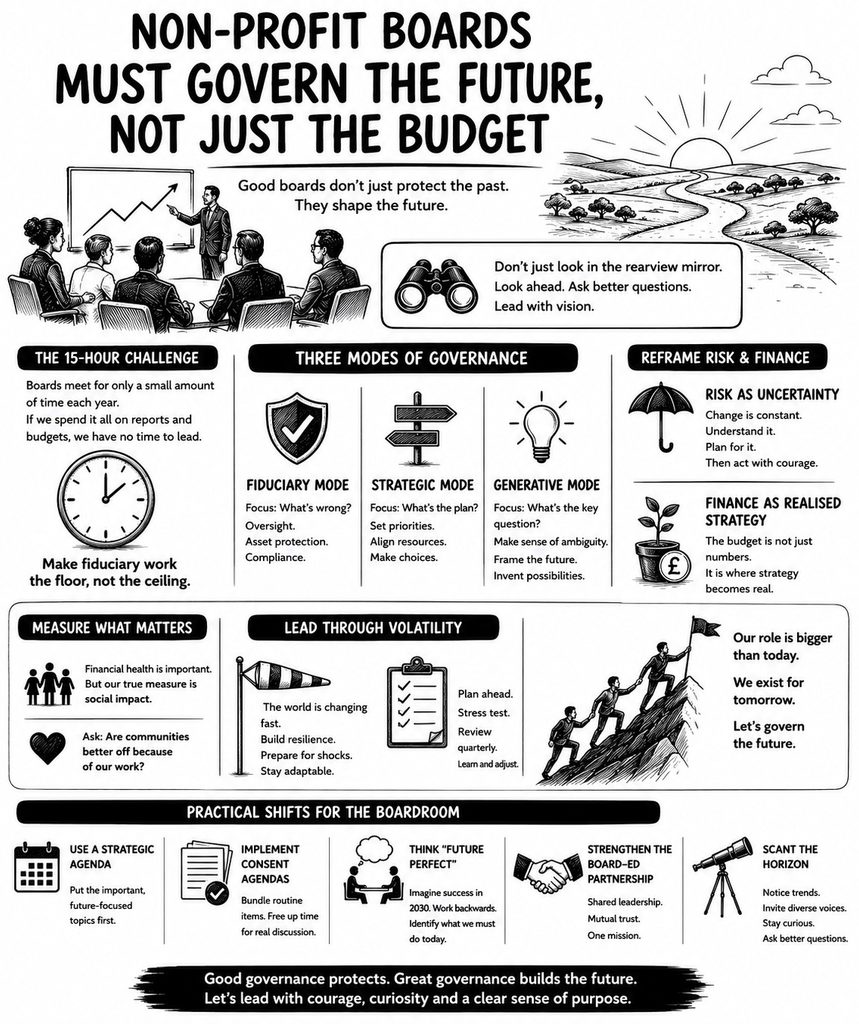
Research suggests that many boards meet for the equivalent of only a few hours each quarter, often less than 15 to 20 hours annually.
Think about that for a moment.
An organisation that may employ dozens of staff, manage millions of pounds or dollars, influence public policy and serve thousands of people is ultimately guided by a group of people who collectively spend fewer than twenty hours together each year.
Time, therefore, becomes one of the board’s most valuable resources.
If every minute is consumed by committee reports, financial updates and operational discussions, there is almost no opportunity to think strategically.
Good governance is not simply about having meetings.
It is about deciding what deserves the board’s limited attention.
Governance Is More Than Fiduciary Oversight
Financial oversight is often seen as the primary responsibility of boards.
It is certainly one of the most important.
Boards must ensure that resources are used responsibly, risks are managed and legal obligations are fulfilled.
However, governance experts increasingly describe board leadership as operating across three different modes.
1. Fiduciary Governance
This is the traditional role.
It focuses on accountability.
Board members ask questions such as:
- Are finances sound?
- Are risks being managed?
- Are policies being followed?
- Are we complying with regulations?
These are essential questions.
Without good fiduciary governance, organisations quickly lose credibility.
But fiduciary governance alone cannot prepare organisations for tomorrow.
2. Strategic Governance
Strategic governance asks different questions.
Instead of focusing only on protecting existing resources, it asks:
- Where are we going?
- What priorities matter most?
- Which opportunities should we pursue?
- What investments will create greater impact?
Here the board helps shape direction rather than simply monitor performance.
Strategy becomes about making choices rather than approving plans.
3. Generative Governance
This is perhaps the least understood, but arguably the most important, role of modern boards.
Generative governance asks questions before anyone has the answers.
Instead of asking:
“How do we solve this problem?”
It asks:
“Are we solving the right problem?”
Rather than responding to change, boards begin interpreting change.
They make sense of uncertainty.
They notice weak signals before they become major trends.
They ask:
- What is changing around us?
- What assumptions are we making?
- What if our current model becomes obsolete?
- What will our community need five years from now?
- What conversations are we not having?
This is where leadership moves beyond governance as oversight towards governance as imagination.
The Future Cannot Be Managed Using Yesterday’s Assumptions
Many organisations unknowingly continue operating based on assumptions that were true twenty years ago.
For example:
- What if grants become harder to secure?
- What if younger generations choose different forms of civic engagement?
- What if Artificial Intelligence changes how services are delivered?
- What if communities expect greater ownership of programmes?
- What if trust becomes a more valuable organisational asset than size?
These are not operational questions.
They are governance questions.
Boards should be creating space for these conversations long before they become urgent.
Money Matters but Mission Matters More
Many boards unintentionally equate financial health with organisational success.
A healthy bank account certainly matters.
However, a financially stable organisation can still fail its mission.
Likewise, organisations sometimes become so focused on fundraising that they lose sight of why they exist.
Budgets are important because they make strategy possible.
A budget is not the strategy itself.
The budget should reflect the organisation’s priorities, not determine them.
The sequence matters.
The board should first ask:
“What future are we trying to create?”
Only then should it ask:
“How do we allocate resources to achieve it?”
When budgets drive strategy instead of strategy driving budgets, organisations slowly drift away from their purpose.
Risk Should Be Reimagined
Traditionally, boards have viewed risk as something to avoid.
But uncertainty is now part of everyday leadership.
Future-focused boards understand that risk is not simply about preventing failure.
It is about preparing for change.
This means asking:
- Which risks threaten our mission?
- Which opportunities are emerging?
- What happens if our largest donor withdraws?
- How resilient is our income model?
- Could new technology strengthen our work?
- Which partnerships will matter most?
Boards that ignore uncertainty do not reduce risk.
They simply become surprised by it.
Measuring What Really Matters
Many board papers are filled with financial figures, activity reports and project updates.
These are useful.
But they tell only part of the story.
Boards should spend equal time discussing questions such as:
- Are communities experiencing lasting change?
- What evidence shows our work is improving people’s lives?
- What are we learning?
- What has not worked?
- What should we stop doing?
Impact should become as routine a discussion as income and expenditure.
After all, communities, not spreadsheets are the reason non-profits exist.
Practical Changes Every Board Can Make
Improving governance does not necessarily require more meetings.
It requires different conversations.
Several practical changes can make a significant difference.
Put strategic issues first: Energy is highest at the beginning of meetings. Reserve this time for future-focused discussions rather than routine reporting.
Use consent agendas: Routine approvals, committee reports and standard updates can be approved together unless discussion is requested. This creates more time for meaningful dialogue.
Schedule future conversations: Dedicate at least one board meeting each year entirely to long-term trends rather than operational updates.
Conduct strategic stress tests: Ask how the organisation would respond if funding fell by 30%, technology disrupted service delivery or community expectations changed dramatically.
Spend time scanning the horizon: Invite external speakers, researchers, young leaders and community representatives to challenge assumptions and introduce emerging trends.
Ask better questions: Sometimes the quality of governance depends less on the answers than on the questions being asked.
The Board and Executive Director Must Lead Together
One of the strongest organisations has a healthy partnership between the board and the Executive Director
The board should not become involved in day-to-day management.
Neither should it remain distant from strategic thinking.
The relationship works best when both recognise they are leading different parts of the same system.
The Executive Director focuses on leading today’s organisation.
The board focuses on ensuring the organisation remains relevant tomorrow.
Neither can succeed without the other.
Governing for 2046, Not Just 2026
Perhaps every board should ask itself one simple question at the beginning of every year:
“If our organisation disappeared tomorrow, would our community miss us?”
If the answer is uncertain, then the board’s responsibility extends far beyond approving budgets.
It must rethink relevance.
The most successful non-profit boards of the future will not be remembered because every audit was clean, although that remains essential.
They will be remembered because they anticipated change before others saw it.
Because they invested in innovation before it became fashionable.
Because they strengthened organisational resilience before crises arrived.
Because they governed with courage rather than caution.
And because they understood that their greatest responsibility was not simply protecting today’s organisation.
It was ensuring the organisation would still matter tomorrow.
Reflection
The role of a non-profit board is changing.
Communities need boards that are curious rather than complacent, courageous rather than comfortable, and future-focused rather than solely finance-focused.
Budgets will always matter. Accountability will always matter. Compliance will always matter.
But these are the foundations of governance, not its highest expression.
The real responsibility of a board is to ensure that the organisation remains relevant, resilient and capable of fulfilling its mission in a world that is changing faster than ever before.
The question every board should ask is no longer simply:
“Did we spend the money well?”
It should also be:
“Are we preparing the organisation for the future our communities will need?”