
For decades, many African non-profit organisations have depended heavily on grants from international donors. These grants have supported important work in health, education, governance, climate action, human rights and humanitarian response. They have helped improve millions of lives across the continent.
However, the funding landscape is changing rapidly.
Governments in Europe and North America are reducing aid budgets. Philanthropic priorities are shifting. Competition for grants is increasing, while donor requirements continue to grow. At the same time, African organisations are being asked to deliver greater impact with fewer resources.
The question is no longer whether African non-profits should diversify their income.
The question is whether they will still be financially sustainable ten years from now if they do not.
By 2036, successful African non-profits will not rely on a single source of funding. Instead, they will build balanced financial portfolios that combine grants with locally generated income, investments and innovative financing.
Financial sustainability is no longer simply about raising more money.
It is about organisational sovereignty.
It is about having the freedom to pursue your mission without constantly changing direction to follow the latest donor priorities.
Here are five income streams every African non-profit should begin building today.
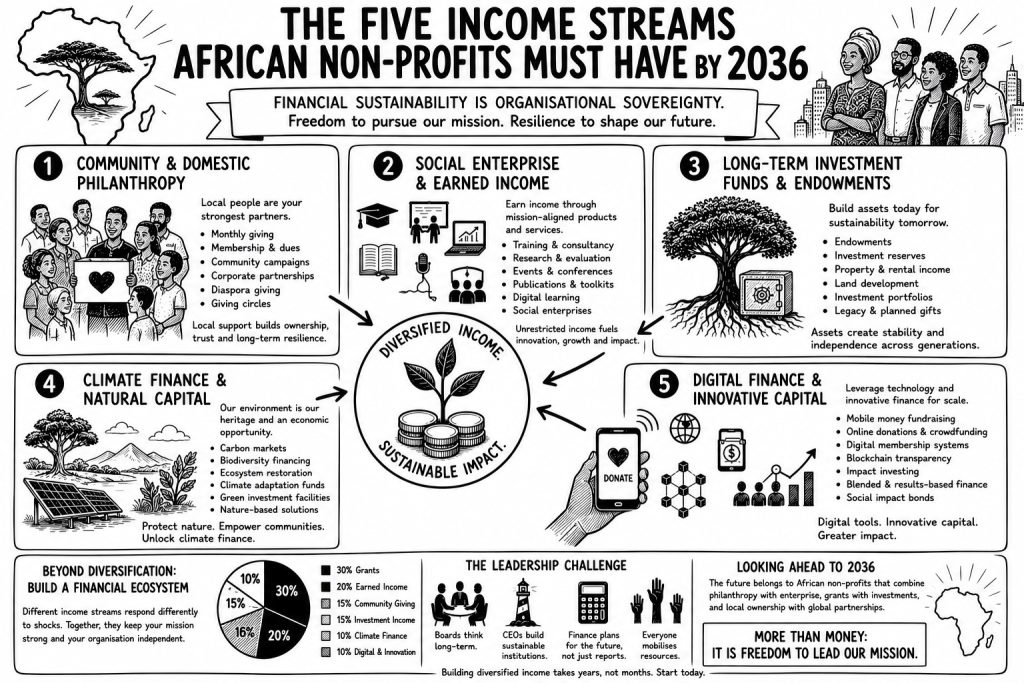
1. Community and Domestic Philanthropy
The strongest organisations are supported by the communities they serve.
Across Africa, giving has always existed. Families contribute towards education. Communities support healthcare costs. Religious institutions mobilise resources for vulnerable people. Friends contribute during funerals, weddings and emergencies. Informal savings groups help members invest in businesses and household needs.
Giving is already part of African society.
The challenge is that much of this generosity remains informal and disconnected from organised social change.
By 2036, African non-profits should have structured systems that enable individuals, businesses, alumni, professional associations and communities to contribute regularly.
This could include:
Monthly giving programmes.
Community fundraising campaigns.
Membership contributions.
Payroll giving.
Corporate partnerships.
Diaspora giving platforms.
Giving circles.
The value of local giving goes beyond money.
When local people invest in an organisation, they become advocates, ambassadors and defenders of its mission.
A thousand people contributing modest amounts every month often creates stronger long-term resilience than one large donor providing a grant for three years.
Financial independence begins with community ownership.
2. Social Enterprise and Earned Income
Many African non-profits possess valuable knowledge, expertise and networks that others are willing to pay for.
Yet many organisations continue giving away services that could generate unrestricted income.
By 2036, every mature non-profit should operate at least one mission-aligned income-generating venture.
This does not mean abandoning charitable work.
It means using business approaches to strengthen social impact.
Examples include:
Leadership and governance training.
Consultancy services.
Research and evaluation.
Digital learning platforms.
Conferences and events.
Publications and toolkits.
Certification programmes.
Co-working and innovation spaces.
Venue hire.
Advisory services.
Some organisations may establish social enterprises in agriculture, renewable energy, technology or creative industries.
The important principle is simple.
Income generation should reinforce the mission rather than distract from it.
When managed well, earned income provides unrestricted funding that allows organisations to innovate, invest in staff, strengthen systems and respond quickly to emerging challenges.
3. Long-Term Investment Funds and Endowments
Every organisation should aspire to own assets that generate income.
For too long, many African non-profits have spent every grant they receive without building lasting financial capital.
Imagine if every organisation invested a small percentage of unrestricted income every year.
After ten years, many would have created significant reserves.
An endowment is more than a savings account.
It is a permanent investment fund where the capital remains protected while investment returns support organisational work year after year.
Alongside endowments, organisations should also explore:
Investment reserves.
Property investments.
Rental income.
Land development.
Investment portfolios.
Legacy giving.
Planned gifts.
These assets create stability during funding shocks.
When grants decline, organisations with investment income can continue operating without immediately cutting programmes or laying off staff.
Financial resilience comes from owning assets, not simply managing projects.
4. Climate Finance and Natural Capital
Africa possesses some of the world’s most valuable environmental assets.
Its forests, wetlands, coastlines, biodiversity and agricultural landscapes play a critical role in addressing climate change.
These assets also create financial opportunities.
Climate finance is expected to become one of the fastest-growing sources of development funding over the coming decade.
African non-profits working in environmental conservation, agriculture, livelihoods and community development should begin positioning themselves to access:
Carbon markets.
Biodiversity financing.
Ecosystem restoration funding.
Climate adaptation funds.
Green investment facilities.
Nature-based solutions financing.
Many organisations already protect forests, restore degraded land or support sustainable farming.
These activities may generate environmental value that can attract climate finance when properly measured and verified.
Climate funding should not be viewed only as an environmental opportunity.
It is increasingly becoming an economic opportunity for communities and civil society.
Those who prepare early will be well positioned as these markets continue to mature.
5. Digital Finance and Innovative Capital
The next generation of philanthropy will be increasingly digital.
Younger donors are giving differently.
They expect speed, transparency and convenience.
They want to donate online, track impact in real time and engage directly with organisations.
By 2036, African non-profits should be comfortable using digital financial tools such as:
Mobile money fundraising.
Online donation platforms.
Digital membership systems.
Crowdfunding campaigns.
Cryptocurrency donations where legally permitted.
Blockchain-enabled transparency tools.
Artificial intelligence to personalise donor engagement.
Beyond fundraising, organisations should also understand innovative financing approaches such as:
Blended finance.
Impact investing.
Results-based financing.
Social impact bonds.
Development impact investments.
These mechanisms allow non-profits to work alongside governments, philanthropists and private investors to address complex social challenges at greater scale.
While they may not suit every organisation today, they are likely to become increasingly important over the next decade.
Future-ready organisations will understand how these financial ecosystems work.
Building a Financial Ecosystem
The biggest mistake organisations make is believing diversification simply means adding more donors.
That is not diversification.
It is concentration spread across multiple grant makers.
True diversification means building different types of income that respond differently to economic shocks.
Imagine an organisation whose income comes from:
30% grants.
20% earned income.
15% community giving.
15% investment income.
10% climate finance.
10% digital fundraising and innovation.
If one income stream declines, the organisation remains stable.
This is how resilient institutions are built.
The Leadership Challenge
Developing these five income streams requires a different type of leadership.
Boards must think beyond annual fundraising targets.
Executive Directors must become architects of sustainable institutions rather than managers of projects.
Finance teams must move beyond accounting to long-term investment planning.
Programme staff must recognise that resource mobilisation is everyone’s responsibility.
Most importantly, organisations need patience.
Building diversified income takes years, not months.
There are no shortcuts.
The strongest institutions begin preparing long before a financial crisis arrives.
Defining Decade
The African non-profit sector is entering a defining decade.
The organisations that survive and thrive by 2036 will not necessarily be those receiving the largest grants today.
They will be those that deliberately build resilient financial ecosystems, invest in long-term assets and strengthen relationships with their communities.
The future belongs to organisations that combine philanthropy with enterprise, grants with investments, and local ownership with global partnerships.
The goal is not simply financial sustainability.
It is institutional freedom.
Because when African non-profits control more of their own resources, they gain something even more valuable than money.
They gain the confidence and independence to define their own priorities, invest in their own ideas and shape Africa’s future on their own terms.