
For three days in Accra, from 1–3 September 2026, we gathered around an idea that is deceptively simple but deeply consequential: Africa must be at the centre of shaping its own development.
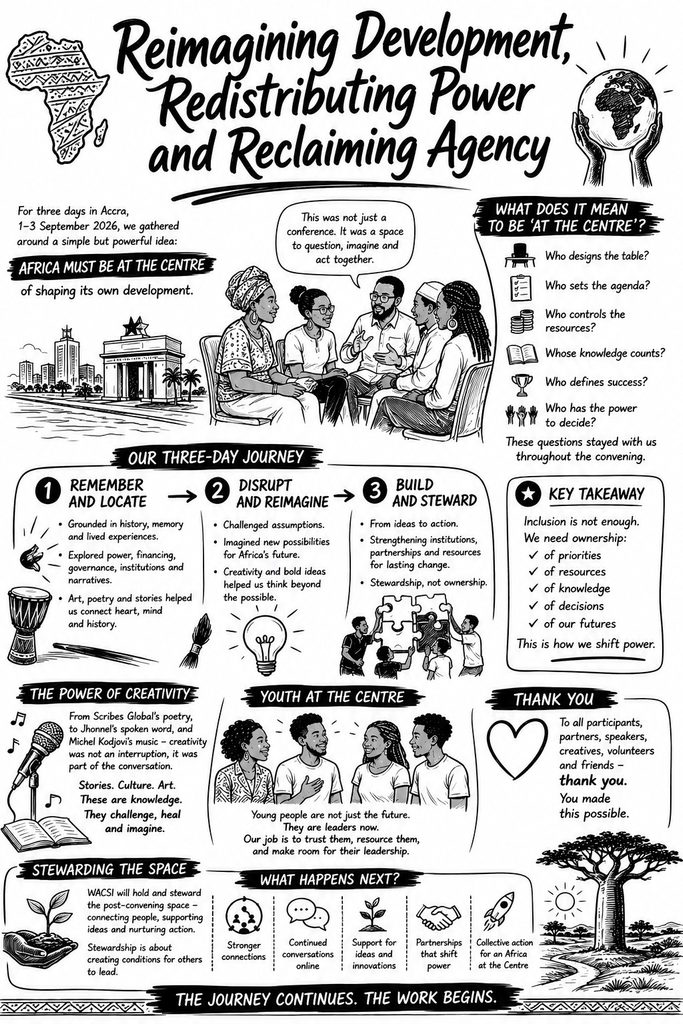
As members of the organising team, we entered the convening knowing that the theme, Africa at the Centre: Leading Change, Shifting Power, would require more than another conference filled with speeches, panels and recommendations. We wanted to create a space where people could pause, question the systems in which we work, listen differently, imagine alternatives and, importantly, begin to think about what collective action might look like beyond the convening.
Yet, as the three days unfolded, the proposition became more complicated. Being ‘at the centre’ is not simply about having a seat at the table. It is about who designs the table, who sets the agenda, who controls the resources, whose knowledge counts, who defines success and who ultimately has the power to decide.
That question stayed with me throughout the convening. As an organising team, we were not outside the conversation. We were part of it. We were also confronted by the same questions we were inviting others to consider.
Are we really shifting power, or have we simply become better at talking about it? That became one of the questions beneath the questions.
Designing a journey, not simply an event
We deliberately designed the three days as a journey:
- Remember and Locate.
- Disrupt and Reimagine.
- Build and Steward.
The sequence mattered.
Before imagining a different future, we need to understand the forces that brought us here. Before disrupting existing systems, we need the courage to imagine beyond them. And before we claim transformation, we need to think seriously about the institutions, relationships, resources and practices required to sustain it.
Looking back, the journey also reminded us that systems change is rarely linear. We move backwards and forwards between memory and imagination, disruption and construction, questioning and action.
The convening was therefore not intended to produce a single answer. It was intended to create the conditions for better questions, deeper relationships and new possibilities. And in many ways, the people in the room did exactly that.
Day One: Remember and Locate
We began with art. The opening artistic intervention featuring the National Dance Company, immediately signalled something important, culture, memory, identity and lived experience has a place alongside policy, financing, institutions and systems. For us as organisers, this was intentional.
Development conversations can become dominated by the language of frameworks, indicators, funding mechanisms, policies and institutional strategies. These tools matter, but they do not always capture the emotional and human dimensions of development. Art can reach places that policy language cannot.
It carries memory.
It provokes emotion.
It challenges assumptions.
It creates room for imagination.
The opening welcome from Dr. Nana Asantewa Afadzinu, Executive Director of WACSI, alongside Stella Opoku-Owusu of AFFORD and Rose Maruru, Co-founder and Executive Director of EPIC Africa, established the tone for the days ahead.
This was not simply a conversation about improving programmes. It was about questioning the relationships, structures and assumptions that determine how development is imagined and delivered.
Ms. Bell Ribeiro-Addy, Member of Parliament for Clapham and Brixton Hill, brought the African diaspora into the conversation and connected the discussion to the wider political environment in which Africa’s development continues to be debated.
The opening address by Ghana’s Presidential Special Envoy for Reparations, Ambassador Ekow Spio-Garbrah, together with Kizito Ballans, brought historical and political depth to the question of agency. The message was difficult to ignore. Today’s development system did not emerge in a vacuum. Colonialism, extraction, unequal economic relationships and global governance structures have shaped and continue to shape who controls resources, whose knowledge is valued and who gets to determine priorities.
We therefore cannot have a serious conversation about development without having a serious conversation about power.
From receiving development to setting the terms
The morning fireside dialogue, moderated by Omolara Balogun of WACSI, brought together Arthur Larok of ActionAid International, Nafissatou Sene of African Collaborative, Bell Ribeiro-Addy and Makmid Kamara of Reform Initiatives.
The central question was direct: What is limiting African-led development from thriving?
The discussion exposed a tension that many of us working in development have experienced.
The language has changed. We now speak about localisation, partnership, participation, ownership and locally led development. But the structures underneath those words have not always changed at the same pace. An African organisation can be called a partner while another organisation controls the resources. A community can be consulted without having meaningful influence over the solution. African researchers can generate knowledge without determining how that knowledge is interpreted or used.
A local organisation can lead implementation while strategic decisions are made elsewhere.
This is why localisation cannot simply mean moving implementation closer to the people. It must also mean shifting decision-making power, resources, ownership and accountability. The afternoon thematic dialogues helped deepen this thinking across four interconnected areas: power, partnerships and global governance; financing Africa’s future; future-ready African institutions; and development, mindsets and narratives.
The sessions, led by colleagues including Harrison Owusu and Elvina Quaison; John Frinjuah and Anab Mohammed; Nancy Kankam Kusi and Melissa Juisi Simo; and Farouk Alhassan and Mabel Shu Lum, created spaces for participants to interrogate different dimensions of the same challenge.
Power must shift in partnerships.
Resources must shift in financing.
Decision-making must shift within institutions.
And narratives must shift in how Africa understands and represents itself.
Remembering through voice
One of the decisions we made as an organising team was to create space for creativity throughout the convening.That choice became increasingly significant as the days progressed.
On Day One, Scribes Global brought poetry into the programme.
Their performance gave another dimension to the invitation to Remember and Locate. Memory is not held only in archives, reports and historical records.
It lives in language.
It lives in oral traditions.
It lives in stories.
It lives in music and poetry.
And it lives in the memories carried from one generation to another. Scribes Global reminded us that the struggle for African agency is also a struggle over narrative.
Who tells Africa’s story matters.
The performance helped us move from simply remembering Africa’s past to asking what those memories mean for the development choices we make today. By the end of the first day, the question had begun to shift.It was no longer simply:
What is wrong with the development system? It was becoming:
What would it take for African agency to become the organising principle of development?
Michel Kodjovi and the power of young creative voices
The creative thread continued during the group dinner through Michel Kodjovi, a WACSI intern.Michel’s contribution was significant not simply because he is young, but because it demonstrated what becomes possible when young people are given space to bring their full selves into a community.There was something particularly powerful about this happening outside the formal conference setting.
Development spaces often place enormous emphasis on panels, presentations and structured dialogue. But some of the most meaningful exchanges happen around tables. At dinner. In corridors. During informal conversations. These are spaces where relationships are built. And relationships are often where power begins to shift. Michel reminded us that young people should not be treated simply as beneficiaries, audiences or representatives of ‘the next generation’. They are already creators of knowledge, culture, movements and solutions. Youth participation therefore has to become more than attendance. It must become agency.
Day Two: Disrupt and Reimagine
If Day One asked us to understand where we are, Day Two asked us to imagine where we could go.The provocation was deliberately bold:
What if Africa dictated the rules?
This was perhaps the most uncomfortable question of the three days because imagination requires us to temporarily suspend the limitations of the present. I had the privilege of serving as lead facilitator for the Disrupt and Reimagine laboratories. Together with the organising team, we challenged participants to move beyond diagnosing problems and to explore practical alternatives. The laboratories brought together provocations around power, partnerships and global governance; financing Africa’s future; future-ready African institutions; and development, mindsets and narratives.
Ms. Engwase Banda Mwale challenged participants to think differently about power and global governance. Ms. Wanjiru Kanyiha opened questions around financing Africa’s future. Moulaye Camara provoked thinking around future-ready African institutions. Ms. Ese Emerhi invited participants to reconsider development through an African worldview.
The intention was not to produce another list of recommendations that would be filed away after the conference. We wanted participants to ask:
What is already happening differently?
Who is already doing it?
What can we learn from those experiments?
And what would it take to help them thrive?
Africa is not short of ideas
One of the strongest lessons from the laboratories was that Africa is not short of ideas.Across the continent, communities, civil society organisations, movements, researchers, entrepreneurs, philanthropists and institutions are already developing alternatives.The challenge is that these ideas are often fragmented, under-resourced or insufficiently connected.Too often, the development system begins with a deficit question:What does Africa need? Perhaps we need to ask a different question: What does Africa already know, already have and already do and what would help those solutions flourish?
That shift is profound.
It changes the relationship between funder and grantee.
It changes the relationship between international organisation and African partner.
It changes the relationship between development practitioner and community.
Instead of asking, What solution can we bring?, we begin by asking:
What is already working, who is doing it, and what can we do to support it? That is a different development posture.It begins with recognition rather than deficit.
Disrupting through words
On Day Two, Jhonnel brought spoken word into the conversation.His performance was fitting for a day dedicated to disruption and reimagination.Spoken word can challenge us in ways that conventional presentations sometimes cannot.
It unsettles.
It provokes.
It questions.
It refuses easy answers.
Jhonnel reminded us that disruption does not always begin with a new policy, institution or funding model. Sometimes it begins with a different story. A different question. A different way of seeing. Or simply the courage to challenge an assumption that has become so familiar that we have stopped questioning it.
The performance reinforced something we increasingly felt during the convening: imagination is itself a form of agency.Before we can build something different, we must first be able to imagine that something different is possible.
From solutions brought to Africa to solutions emerging from Africa
The gallery walk that followed gave participants an opportunity to encounter ideas from laboratories they had not personally joined.Elvina Quaison facilitated the process of weaving possibilities, helping participants identify connections across the different conversations.The exercise reflected another important principle of the convening.No single conversation holds the answer.
The future will be built through connections between ideas, institutions, generations, sectors and geographies. The day concluded with the EPIC Africa Civil Society Awards, with Rose Maruru recognising organisations already demonstrating courage, creativity and alternative approaches to development. This was important because it reminded us that African civil society is not waiting for permission to innovate. It is already innovating. The question is whether the wider system is prepared to recognise, resource and learn from that innovation.
Another centre of gravity
The evening youth dialogue, hosted by Deborah Abbey and featuring Diana Akokpari, Diallo Mamadou and Rachael Mwikali, brought another important dimension into the conversation.
As an organising team, we were particularly conscious that youth participation could not simply mean inviting young people into a room and giving them a speaking slot. The deeper question was about power.
Are young Africans being trusted with real responsibility?
Are they shaping institutional priorities?
Are they influencing resource decisions?
Are their ideas being funded?
Are they being given room to experiment?
Are older generations prepared to make space for new forms of leadership?
For too long, young people have been described as ‘the future’. But young Africans are already shaping the present. They are building organisations, leading movements, producing knowledge, creating businesses, developing technologies, making art and organising communities. The challenge is therefore not simply to prepare young people for leadership. It is to create the conditions for them to exercise leadership now.
Day Three: Build and Steward
The third day brought us to perhaps the hardest question:What happens next?
It is relatively easy to gather people around a powerful idea. It is much harder to build the systems, relationships, resources and institutions capable of sustaining that idea. Day Three therefore moved towards Build and Steward.
The morning diaspora engagement dialogue hosted by AFFORD UK recognised the diaspora as much more than a source of remittances. The African diaspora also holds knowledge, capital, professional networks, philanthropy, political influence and social capital. The question is how these assets can be connected more intentionally to African-led development.
Building future-ready African institutions
The conversation on education, civil society, policy and industry, moderated by John Frinjuah of WACSI, brought together Dr. Anita Djoble-D’Almeida of GIMPA, Dr. Moses Isooba of the Uganda National NGO Forum, Dr. Ebrima Sall of TrustAfrica and Dayo Olaide of IdeaPlus.The discussion reinforced an important reality, African development cannot be transformed by civil society alone.Universities, governments, private sector actors, philanthropy, civil society and communities need stronger connections.Knowledge must connect to policy.Policy must connect to practice.Capital must connect to innovation.And institutions must connect to the people they exist to serve.
Ideas in Motion
The Ideas in Motion pitching session created another bridge between conversation and action.
Jimm Chick Fomunjong moderated the session, with Chamrid Kpadonou of African Collaborative, Franck Sombo of WACSI and Tendisai Chigwedere of the Hewlett Foundation serving as reviewers. The seed-funding opportunity was particularly important because ideas require more than applause. They require resources. Experiments require room. Innovators require trust. And systems change requires patient stewardship. The session therefore represented an important attempt to ensure that the energy generated in the room could move beyond the room.
From memory to stewardship
Scribes Global returned on Day Three, creating a beautiful creative bookend to the convening.On Day One, their poetry helped us remember and locate.On Day Three, their return helped us think about what it means to build and steward.That progression felt deeply appropriate.
If the first question is Who are we? And the second is What might be possible? Then the third becomes: What are we prepared to build and what are we prepared to sustain?
Their return reminded us that stewardship is not only about institutions, financing and governance. It is also about memory. It is about nurturing imagination. It is about ensuring that future generations inherit more possibilities than those we inherited.
The creatives were not an interruption to the conversation
Looking back, I am particularly grateful that we created space for the creatives.Scribes Global, Jhonnel and Michel Kodjovi reminded us that development is not only negotiated in boardrooms, policy spaces and funding discussions.It is also expressed through poetry, spoken word, rhythm, culture, storytelling and imagination.Their contributions were not decorative moments between the ‘serious’ conversations.They were part of the serious conversation.They helped us remember.They helped us question.They helped us feel.They helped us imagine.And they reminded us that narrative is itself a site of power.Whoever tells the story influences how the problem is understood.Whoever defines the problem often influences the solution.And whoever controls the narrative can influence what people believe is possible.This is why creativity belongs at the centre of conversations about development and systems change.
From inclusion to ownership
One of the reflections I take most strongly from the convening is that inclusion is not enough.
For years, the development sector has become increasingly comfortable with the language of inclusion. Include local organisations. Include communities. Include women. Include young people. Include African voices. But someone can be included in a conversation without influencing its outcome.
An organisation can be included in a partnership without controlling the resources. A community can be consulted without determining the solution. A young person can be invited to speak without being given decision-making power. Africa at the Centre invites us towards something deeper, ownership.
Ownership means meaningful influence over priorities. Ownership means having a say in how resources are allocated. Ownership means defining what success looks like. Ownership means recognising African knowledge as knowledge not simply as local experience waiting for external validation. And it also means recognising African creativity as knowledge. Poetry is knowledge. Music is knowledge. Storytelling is knowledge. Art is knowledge. Culture is knowledge. These forms carry histories, values, critique and visions of the future. They belong in the centre.
The responsibility is also ours
As an organising team, we cannot ask others to shift power without examining the power we ourselves hold.That is one of the uncomfortable lessons of this work.African institutions must also strengthen accountability.Civil society must be prepared for greater responsibility as it demands greater autonomy.Funders must rethink risk, while local organisations must continue strengthening the systems required to manage resources responsibly.International organisations must be willing to relinquish control, while African actors must be ready to exercise greater influence with integrity.And all of us must recognise that shifting power is not simply about transferring power from one actor to another. The goal is to build healthier systems of shared power, accountability and agency.
Stewardship, not ownership
The final conversation brought this question of stewardship into sharper focus.Dr. Nana Asantewa Afadzinu outlined WACSI’s intention to hold and steward the post-convening space, including supporting follow-up, coordination and the development of a platform through which the work can continue. The distinction between stewardship and ownership is important. Stewardship is not about controlling the agenda. It is about creating the conditions for others to lead.It is about holding relationships without owning them.It is about connecting people and ideas without determining all the outcomes.And it is about ensuring that a moment of collective energy can become something more durable.That is the responsibility we carry from Accra.
What happens after Accra?
This is how Africa at the Centre should ultimately be judged.Not by attendance.Not by photographs.Not even by how powerful the conversations felt in the room.The real test is what happens next.Will partnerships change?Will funding practices change?Will African organisations have greater control over resources?Will communities have greater influence over decisions affecting their lives?Will young Africans move from participation to leadership?Will African knowledge systems be valued differently?Will African creatives be recognised as contributors to development rather than simply entertainers at development events?Will the ideas emerging from the laboratories and the pitching receive the support needed to grow?And will the relationships created in Accra continue to generate collective action?
These questions matter because shifting power is not an event. It is a practice. It is a discipline. It is a long-term commitment.
A journey that continues
The three days gave us a space to remember, locate, disrupt, reimagine, build and steward. The creatives helped us experience that journey in another language, the language of voice, culture and imagination. We remember through stories. We disrupt through voice. We reimagine through creativity. We build through collective action. And we steward by creating space for others to lead. The question is no longer whether Africa should be at the centre. The question is what each of us is prepared to change to make that centre real. That is the work ahead. And that is the invitation we carry with us from Accra.