
One of the biggest myths in African development is that there is not enough local philanthropy.
The truth is quite different.
Africa has always been generous.
Across our communities, people contribute to school fees, support neighbours during illness, build community facilities, contribute to churches and mosques, help families during funerals and weddings, and participate in savings groups and rotating credit schemes. Every day, millions of Africans give their money, time, knowledge and networks to help others.
The problem is not the absence of generosity.
The problem is that very little of this generosity is intentionally organised to strengthen civil society organisations.
Many African non-profits continue to look outside the continent for funding while overlooking the enormous potential that exists within their own communities.
If we are serious about achieving financial sustainability by 2036, they must deliberately build systems that convert informal generosity into organised, predictable and long-term support.
The question is not whether people are willing to give.
The question is: How do we make it easier, more meaningful and more rewarding for them to do so?
Here are practical steps every African non-profit can begin implementing today.
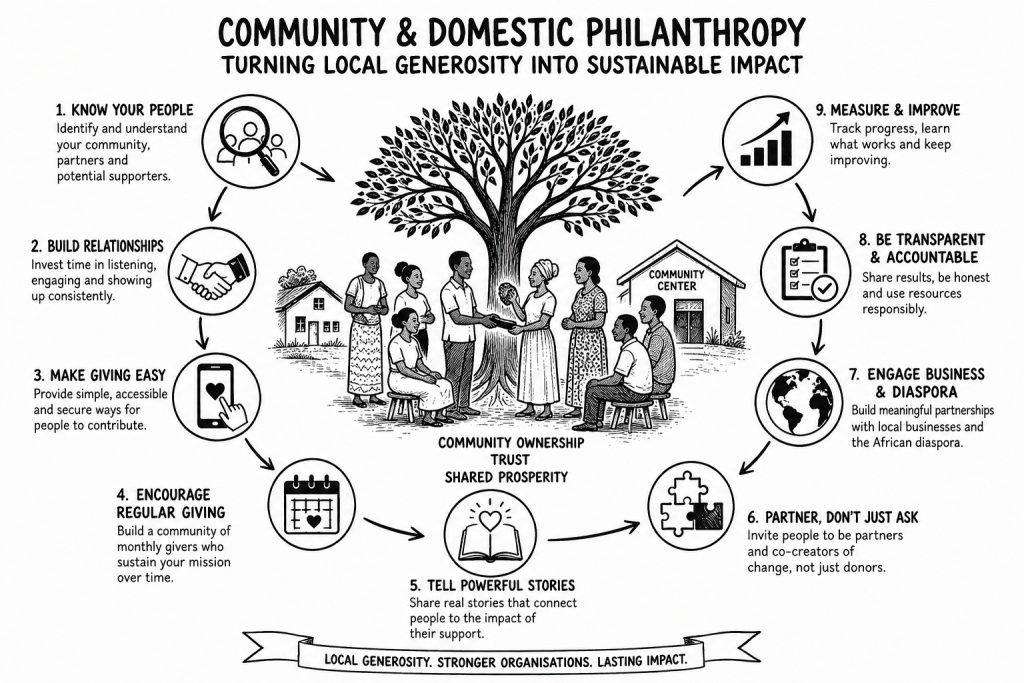
1. Start by changing your mindset
Domestic fundraising should never be viewed as a backup plan when donor funding disappears.
It should become a core part of your business model.
Many organisations unconsciously believe that communities are beneficiaries while donors are funders.
This thinking limits possibilities.
Communities are not only beneficiaries.
They are investors.
They are partners.
They are co-owners of the change your organisation exists to create.
Leadership teams should therefore begin every fundraising discussion by asking:
“What percentage of our income comes from the people whose lives we seek to improve?”
If the answer is close to zero, there is work to do.
2. Know exactly who can support your organisation
Many organisations make the mistake of asking everyone for support.
Successful fundraising starts with understanding your constituency.
Map your potential supporters.
These could include:
- Community members
- Former beneficiaries
- Alumni
- Faith communities
- Local businesses
- Professional associations
- Traditional authorities
- Market women associations
- Cooperatives
- Youth groups
- Foundations
- The African diaspora
Each group will support you for different reasons.
Understanding their motivations allows you to design appropriate engagement strategies rather than using one fundraising approach for everyone.
3. Build relationships before asking for money
Fundraising begins long before the donation request.
People rarely support organisations they know very little about.
Instead of asking immediately for financial support, invest first in relationships.
Invite people to visit your programmes.
Organise community conversations.
Share stories about your impact.
Celebrate local volunteers.
Recognise supporters publicly.
Keep people informed about your work.
Trust develops over time.
Money usually follows trust.
4. Make giving easy
Many organisations unintentionally make donating difficult.
A supporter should never have to struggle to find out how to contribute.
Create multiple ways for people to give.
For example:
- Mobile Money
- Bank transfers
- Standing orders
- Debit cards
- QR Codes
- WhatsApp payment links
- USSD short codes
- Website donation buttons
The easier it is to give, the more likely people are to support you.
Remember that convenience is often as important as generosity.
5. Build a monthly giving community
One large donor can leave tomorrow.
One thousand committed supporters often stay for years.
Monthly giving programmes create predictable income that helps organisations plan confidently.
Rather than asking supporters for large annual donations, encourage them to contribute affordable monthly amounts.
For example:
“Become a Community Champion by contributing GHS50 every month.”
“Support one girl’s education for GHS100 monthly.”
“Join 500 changemakers transforming our community.”
These contributions may appear small individually.
Collectively, they become transformational.
6. Tell stories instead of presenting statistics
People rarely give because of numbers.
They give because they connect emotionally with people.
Instead of saying:
“We trained 500 women.”
Tell the story of one woman whose business doubled after receiving training.
Instead of saying:
“We planted 20,000 trees.”
Tell the story of a farming family whose harvest improved because degraded land was restored.
Stories help people understand the human impact behind the numbers.
7. Invite people to become partners, not donors
Language matters.
Rather than calling people donors, think about building a community of partners.
Partners feel ownership.
Partners stay involved.
Partners introduce others.
Partners defend your organisation during difficult times.
The goal is not simply to raise money.
The goal is to build a movement around your mission.
8. Work with local businesses differently
Corporate partnerships should not begin with sponsorship requests.
Start by understanding the business.
What challenges are they trying to solve?
How does your work align with their purpose?
Explore opportunities beyond financial donations.
Businesses can provide:
- Staff volunteering
- Professional expertise
- Office equipment
- Training
- Technology
- Mentoring
- Payroll giving
- Joint campaigns
Long-term partnerships usually create more value than one-off sponsorships.
9. Engage the African diaspora intentionally
The African diaspora contributes billions of dollars to the continent every year.
Most of this supports families directly.
But many people also want to contribute to lasting social change.
Develop dedicated diaspora engagement strategies.
Organise virtual briefings.
Provide regular impact reports.
Create transparent giving platforms.
Invite diaspora professionals to mentor young people.
Allow them to contribute knowledge, networks and expertise alongside financial resources.
Diaspora engagement is not only about money.
It is about reconnecting people with the development of their communities.
10. Earn trust through radical transparency
Nothing destroys domestic fundraising faster than a lack of accountability.
People want to know:
- Where did my money go?
- What difference did it make?
- How efficiently was it used?
Provide simple financial updates.
Publish annual reports.
Share impact stories.
Celebrate successes.
Be honest about setbacks.
Transparency builds credibility.
Credibility builds confidence.
Confidence builds sustained giving.
11. Measure and improve continuously
Like every other income stream, domestic philanthropy requires continuous learning.
Track:
- Number of active supporters
- Monthly recurring donors
- Average donation size
- Donor retention
- Community participation
- Volunteer engagement
- Corporate partnerships
- Diaspora contributions
Review what works.
Learn from what does not.
Improve every campaign.
Domestic fundraising is not an event.
It is a long-term organisational capability.
Community ownership is the foundation of financial independence
Community philanthropy is about much more than raising money.
It changes the relationship between an organisation and society.
When communities invest in your organisation, they begin to see it as their organisation.
They protect it.
They advocate for it.
They introduce others to it.
They hold it accountable.
And they celebrate its success.
That is the true value of domestic philanthropy.
By 2036, the most resilient African non-profits will not necessarily be those receiving the largest international grants.
They will be those that have built thousands of local supporters who proudly say:
“We are not just beneficiaries of this organisation, we are helping to build it, sustain it and shape its future.”
Because financial sustainability begins with community ownership, and community ownership begins with trust.