One thing I have learnt from working around partnerships in the development and civil society sector is that having a common goal does not necessarily mean people will work well together.
Two organisations can share the same vision, work on the same issues and depend on each other to deliver results, yet struggle to maintain a good working relationship. Sometimes, the problem is not funding, technical capacity or a lack of planning. It is the people involved.
We spend a lot of time discussing partnership agreements, budgets, project proposals, reporting requirements and organisational capacity. All these things are important. But I think we sometimes pay too little attention to the character and temperament of the people expected to make these partnerships work.
Over time, I have come to realise that the success of a partnership depends greatly on who is involved, how they behave and how they treat others when things do not go as planned.
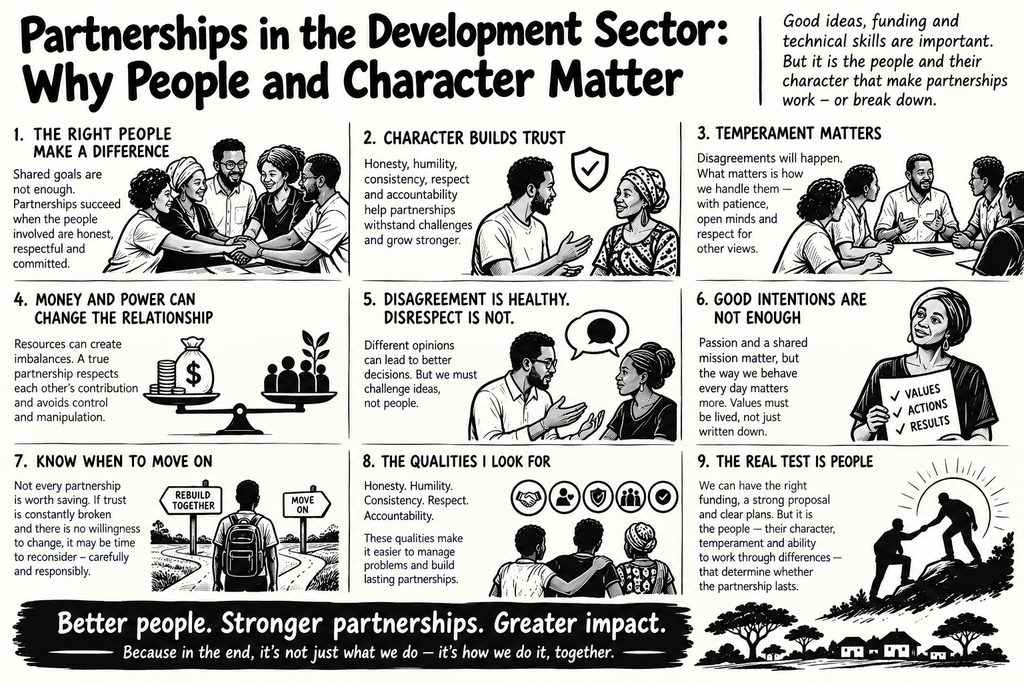
A good partnership starts with the right people
In the development sector, organisations often come together because they care about the same issues. One may have funding, another may have strong community connections, while a third may bring technical knowledge or experience.
On paper, the arrangement makes sense. Each organisation brings something valuable to the table.
But what happens when the people involved have different attitudes towards work, power and responsibility?
I have seen how difficult it can become when one partner believes collaboration means making decisions together, while the other believes that having more money or influence gives them the right to make most of the decisions.
The same problem can arise when one person is willing to listen and compromise, but the other always wants to have the final say.
These differences can slowly damage a relationship, even when everyone claims to be working towards the same goal.
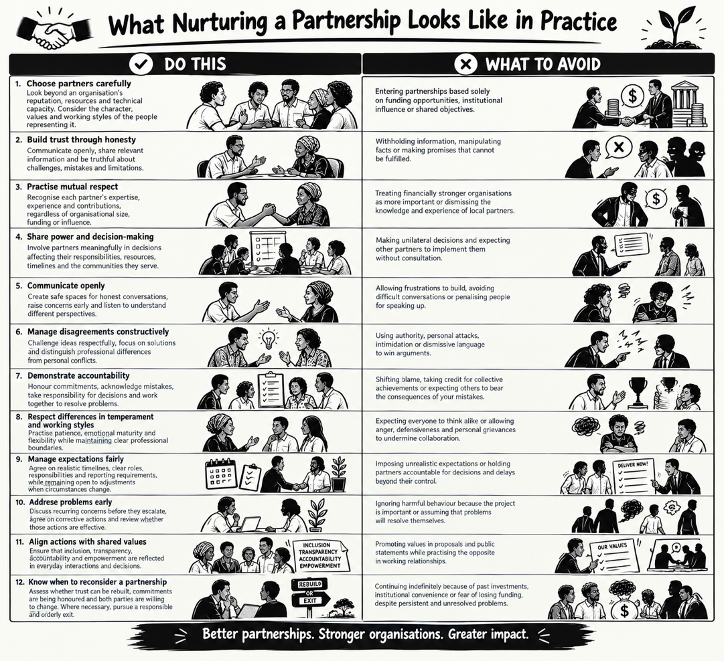
This is why I believe we should look beyond an organisation’s reputation, experience and technical capacity when entering into a partnership. We should also pay attention to the people representing that organisation and how they work with others.
A good organisation on paper does not automatically mean that every person representing it will make a good partner.
Character can make or break a partnership
One of the hardest lessons I have learnt is that bad character can destroy a partnership, regardless of how good the original idea was.
By bad character, I mean behaviour such as dishonesty, manipulation, arrogance, refusing to take responsibility, taking credit for other people’s work and treating colleagues or partners with disrespect.
These behaviours may not become obvious at the beginning. In the early stages, everyone may be friendly, meetings may go well and the excitement of a new project may bring people together.
The real test often comes when there is a disagreement, a mistake or a decision that someone does not like.
Can the person accept criticism? Can they admit when they are wrong? Do they keep their word? Can they disagree without making the other person feel small?
These things matter more than we sometimes admit.
For example, imagine working with a partner who is always happy to take credit when a project succeeds but quickly blames others when something goes wrong. At first, you may try to overlook it. You may even make excuses for the person because the project is important.
But when this behaviour continues, trust begins to disappear. You become careful about what you share, reluctant to take initiative and worried that your efforts may be used against you.
Eventually, the relationship becomes exhausting.
The problem is no longer just about the work. It is about whether you can trust the person you are working with.
A partnership cannot remain strong when one person is constantly protecting their own interests at the expense of everyone else.
Temperament matters, especially when things get difficult
I have also learnt that the way people handle pressure can tell you a lot about what it will be like to work with them.
Some people can disagree with you today and work with you comfortably tomorrow. Others carry disagreements into every conversation and make it difficult to move forward.
Some people listen before responding. Others become defensive as soon as their ideas are questioned.
In the development and civil society sector, we deal with difficult issues, tight deadlines, funding pressures and different expectations. Disagreements are bound to happen. There is no realistic way to avoid them completely.
What matters is how we handle them.
Imagine a local partner raising concerns about a project deadline because community consultations have taken longer than expected. Rather than discussing the issue, the other partner becomes angry and accuses them of being difficult.
That response does not solve the problem. It makes the relationship more difficult and may discourage the partner from raising concerns in the future.
A person with the right temperament can be firm without being rude. They can challenge an idea without attacking the person behind it. They can listen to an uncomfortable opinion without treating it as disrespect.
For me, this is an important quality in anyone who wants to build lasting partnerships.
You do not have to like every opinion your partner expresses. You do, however, need to respect their right to express it.
Money and power can change the relationship
Partnerships in the development sector are not always equal in practice, even when they are described as equal on paper.
One organisation may control the funding, while another is responsible for working directly with communities. The organisation holding the money may have more influence over decisions, timelines and reporting requirements.
This arrangement can work, provided both sides respect what the other brings to the partnership.
The problem starts when the organisation controlling the resources begins to treat the other as a subordinate rather than a partner.
For instance, a funding organisation may change project activities without proper consultation, delay decisions and still expect the local organisation to deliver everything on time. When the local partner raises concerns, it may be reminded who is paying for the work.
This kind of relationship can leave local organisations feeling that their knowledge and experience are valued only when they help deliver the project.
It also creates a situation where people may agree publicly but express their frustration privately because they fear losing funding.
I believe that money should come with responsibility, not an attitude of superiority.
Organisations managing funds have a duty to ensure accountability. Equally, local partners should have a genuine opportunity to contribute to decisions that affect their work and the communities they serve.
A partnership works better when each side recognises the other’s contribution, rather than using its position to control the relationship.
Not every disagreement is a problem, but disrespect is
I do not believe that good partnerships are those in which everyone agrees all the time.
In fact, I would be concerned about a partnership where nobody ever questions a decision. It may mean that everyone is satisfied, but it could also mean that people are afraid to speak.
Different opinions can improve decisions. A partner who points out a weakness in a proposal may be helping to prevent a bigger problem later.
The difficulty comes when people cannot separate disagreement from personal conflict.
I have learnt that there is a big difference between saying, ‘I do not think this approach will work’, and saying, ‘You never know what you are doing.’
The first statement opens a discussion. The second attacks the person.
Unfortunately, some people use their positions, experience or professional standing to dismiss others rather than engage with their arguments.
When this happens repeatedly, people stop speaking honestly. Meetings become formalities, and important concerns remain unaddressed.
A good partner should be able to challenge your thinking without undermining your dignity.
Equally, we must be willing to hear things we may not like. Sometimes, the person questioning our decision may be raising a concern we have overlooked.
The ability to disagree respectfully is one of the qualities I value most in a working relationship.
Good intentions are not enough
Many people enter the development sector because they want to make a difference. They care about communities, inequality, social justice and improving people’s lives.
But working for a good cause does not automatically make someone a good colleague or partner.
A person can speak passionately about inclusion while refusing to listen to other people. An organisation can promote accountability while avoiding responsibility for its own mistakes. A leader can talk about empowerment while insisting on controlling every decision.
This contradiction is something we should be willing to acknowledge.
We cannot judge a partnership only by its mission statement or the values written on its website. We must also look at how those values are reflected in everyday behaviour.
Does the organisation treat its partners fairly? Does it keep its commitments? Does it share information? How does it respond when something goes wrong?
These are practical questions, and the answers often tell us more than a well-written proposal.
For me, the lesson is that good intentions must be supported by good conduct.
Sometimes, you have to accept that a partnership will not work
There is a tendency to keep trying to save a partnership because a lot of time, money and effort have already been invested in it.
This is understandable, especially when the work affects communities that depend on the project.
But there comes a point when we must ask ourselves whether the relationship is still serving its purpose.
If concerns are repeatedly ignored, commitments are constantly broken and one partner shows no willingness to change, continuing the relationship may create more problems than it solves.
Not every difficult relationship needs to end. Sometimes, an honest conversation, clearer responsibilities or changes to the way decisions are made can help.
But where dishonesty, manipulation or persistent disrespect has destroyed trust, it may be necessary to reconsider the partnership.
This should be done carefully, with proper attention to contractual obligations and the people who could be affected.
Still, we should not confuse staying together with working well together.
Some partnerships continue because the organisations need each other financially or institutionally, even when the relationship has become unhealthy.
That is not necessarily a sign of success.
A partnership should be judged by the quality of the work, the trust between those involved and whether the relationship allows both sides to fulfil their responsibilities.
What I now look for in a partner
I have come to value a few simple qualities in the people and organisations I work with.
I value honesty, because without it, there is little reason to trust what someone says.
I value humility, because nobody knows everything, and everyone makes mistakes.
I value consistency, because promises mean very little when they are not followed by action.
I value respect, especially when people disagree or when one person has more power than the other.
And I value accountability, because a good partner should be willing to take responsibility rather than always finding someone else to blame.
These qualities do not mean that a partnership will never face problems. They make it easier to deal with problems when they arise.
I would rather work with someone who can admit a mistake and help find a solution than someone who is always trying to prove that they are right.
I would rather have a difficult but honest conversation than spend months pretending everything is fine.
And I would rather build a relationship with someone who respects the people around them than someone whose reputation looks impressive but whose behaviour repeatedly damages trust.
My biggest lesson
My biggest lesson about partnerships in the development and civil society sector is that the human side of collaboration deserves far more attention.
We can have the right funding, a strong proposal, clear objectives and well-defined roles. But if the people involved lack honesty, respect and the ability to work through disagreements, the partnership will struggle.
The right temperament helps people manage differences. Good character helps them build trust. Respect allows them to challenge one another without destroying the relationship.
None of this means that personality differences should prevent people from working together. We do not have to think alike, behave alike or share the same approach to every problem.
What matters is whether we can work through those differences without losing sight of our responsibilities to one another and to the people our work is meant to serve.
I have learnt that choosing a partner is not just about deciding which organisation has the right resources or experience. It is also about deciding which people you can trust to work with you when things become difficult.
Because, in the end, a good partnership is not built only on what people promise to do. It is built on how they behave when it matters most.