

What Holds Society Together?
When governments want to grow their economies, they invest in infrastructure.
They build roads so people can travel. They build bridges so communities can connect. They invest in electricity so businesses can operate. They improve water systems, schools and hospitals because they understand that without strong infrastructure, development cannot happen.
Yet there is another kind of infrastructure that receives far less attention.
It cannot always be seen, but its absence is quickly felt.
It is civil society infrastructure.
These are the organisations, networks, institutions, leadership systems, digital platforms and community relationships that help societies respond to crises, defend human rights, strengthen democracy, support vulnerable communities and hold those in power accountable.
Without this infrastructure, communities become less resilient. Governments become less accountable. Citizens become less connected. Development becomes harder to sustain.
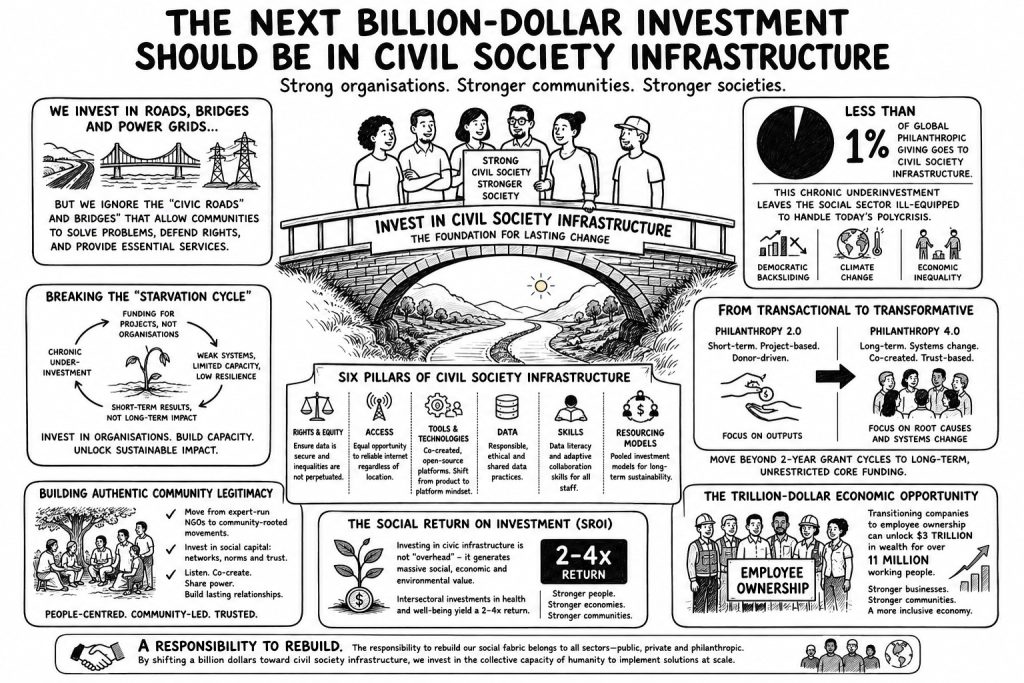
If we are serious about building a better future, perhaps the next billion-dollar investment should not be in another project.
Perhaps it should be in the infrastructure that allows civil society itself to thrive.
The Mistake We Have Been Making
For decades, much of development funding has focused on projects.
Funders have wanted to know:
- How many children went to school?
- How many farmers received support?
- How many trees were planted?
- How many communities benefited?
These are important questions.
But there is another question that is often overlooked.
Who is building the organisations that make these results possible?
Too often, civil society organisations are expected to deliver ambitious results without the systems, technology, leadership or financial stability needed to sustain their work.
Projects are funded.
Organisations are not.
The result is a cycle where organisations spend much of their time chasing grants rather than strengthening the foundations that would allow them to create greater impact over the long term.
Civil Society Infrastructure Is More Than Buildings
When we talk about infrastructure, many people think about offices or equipment.
But civil society infrastructure is much broader.
It includes the systems that enable organisations to perform well and adapt to change.
This includes:
- capable and confident leadership;
- effective governance;
- strong financial systems;
- skilled and motivated staff;
- digital technology;
- secure data systems;
- partnerships and networks;
- learning and knowledge management;
- communications and storytelling; and
- sustainable financing models.
These are not administrative luxuries.
They are the foundations that enable organisations to respond quickly when communities need them most.
The Digital Infrastructure Challenge
Today’s civil society organisations operate in a digital world.
Communities communicate online.
Governments increasingly provide services digitally.
Artificial intelligence is changing how organisations work.
Data is becoming central to decision-making.
Yet many organisations still lack the digital infrastructure needed to operate effectively.
Future investment should therefore go beyond purchasing software.
It should help organisations build the confidence and capability to use technology responsibly.
This means investing in:
- affordable and reliable digital access;
- secure data management;
- ethical use of artificial intelligence;
- open and collaborative technology platforms;
- digital skills for all staff; and
- long-term support rather than one-off technology purchases.
Technology alone does not create impact.
People who know how to use technology well do.
We Need to Fund Organisations, Not Just Activities
One of the biggest challenges facing civil society is the way funding is structured.
Many grants pay for activities but not for the systems required to deliver them.
Staff development is often excluded.
Technology is considered overhead.
Leadership coaching is difficult to fund.
Organisational learning receives little attention.
Ironically, these are often the very investments that determine whether an organisation succeeds or struggles.
Imagine asking a hospital to treat patients without investing in its equipment, staff development or maintenance.
Yet this is exactly what many civil society organisations experience.
If we want stronger organisations, we must be willing to fund organisational strength.
A Different Kind of Philanthropy
This requires a different way of thinking about philanthropy.
Traditional funding often asks:
“What project can we support?”
A more transformative approach asks:
“What systems must exist for communities to solve problems long after this grant has ended?”
This shift changes everything.
Instead of funding isolated activities, funders begin investing in:
- institutions;
- leadership;
- collaboration;
- innovation;
- local knowledge;
- organisational resilience; and
- long-term community capacity.
The goal moves beyond delivering projects.
It becomes strengthening the ecosystem that makes lasting change possible.
Trust Is Also Infrastructure
Civil society infrastructure is not only about systems.
It is also about relationships.
Many organisations have become highly skilled at writing proposals and producing reports.
But some have become less connected to the communities they exist to serve.
Communities increasingly expect organisations to listen before acting.
They want participation rather than consultation.
They want shared decision-making rather than externally designed programmes.
Future investment should therefore strengthen social capital as much as organisational capacity.
Trust is one of the most valuable forms of infrastructure any organisation can possess.
Without trust, even well-funded organisations struggle to create lasting change.
Investing in the People Behind the Mission
Behind every successful organisation are people.
Yet many development professionals work under enormous pressure.
Short-term contracts.
Heavy reporting requirements.
Limited opportunities for learning.
Few resources for leadership development.
If we want organisations that can navigate uncertainty, we must invest in the people leading them.
Leadership development, coaching, peer learning, wellbeing and succession planning should no longer be seen as optional extras.
They are essential investments in the future of civil society.
Why This Investment Makes Economic Sense
Some people still see organisational strengthening as an expense.
It is better understood as an investment.
Strong civil society organisations help improve education, healthcare, environmental protection, democratic governance and economic opportunity.
They prevent crises before they become emergencies.
They strengthen communities before problems escalate.
They support governments while also holding them accountable.
The return on investment is therefore much greater than the cost of building stronger organisations.
Every pound, dollar or cedi invested in civil society infrastructure has the potential to generate value across society for many years to come.
The Future Cannot Be Built on Short-Term Thinking
Many of today’s biggest challenges did not emerge overnight.
Climate change.
Growing inequality.
Youth unemployment.
Shrinking civic space.
Declining public trust.
These problems require long-term responses.
Yet many organisations continue operating through funding cycles lasting only one or two years.
Transforming systems takes time.
Building trust takes time.
Strengthening institutions takes time.
Future investment must therefore be patient, flexible and focused on long-term resilience rather than short-term outputs alone.
A Call to Think Bigger
Imagine what could happen if governments, philanthropists, businesses and development partners collectively invested one billion dollars in strengthening civil society infrastructure.
Thousands of organisations could modernise their systems.
Local networks could become stronger.
Communities could gain greater influence over decisions that affect their lives.
Young leaders could receive the support they need.
Technology could become an enabler rather than a barrier.
Organisations would spend less time surviving and more time solving society’s biggest challenges.
This would not simply strengthen individual organisations.
It would strengthen democracy.
It would strengthen communities.
It would strengthen development itself.
Investing in Society’s Foundations
The strongest buildings are rarely admired because of their foundations.
Yet without strong foundations, no building can stand.
The same is true for civil society.
If we continue funding projects while neglecting the organisations that deliver them, we will continue asking civil society to do more with less.
But if we choose to invest in civil society infrastructure, its people, systems, leadership, technology, networks and long-term sustainability, we create the conditions for lasting change.
The next billion-dollar investment should not simply fund another programme.
It should build the infrastructure that enables communities, organisations and societies to shape their own future for generations to come.