

The recent High Court judgment involving Akonta Mining Company Limited and its owner, Bernard Antwi Boasiako (popularly known as Wontumi), is about much more than one illegal mining case. It raises important questions about accountability, corporate governance, environmental responsibility and the rule of law in Ghana.
For many Ghanaians, galamsey has become one of the country’s greatest environmental challenges. Rivers have been polluted, forests destroyed and farming communities disrupted. Successive governments have promised to tackle the problem, yet illegal mining has continued to thrive.
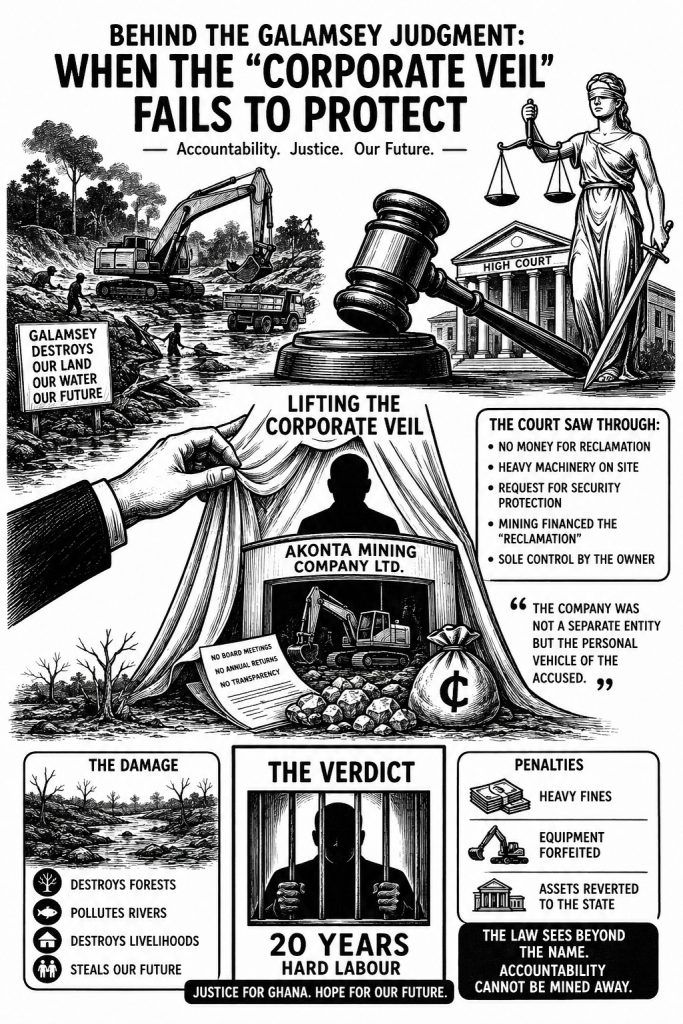
This judgment is significant because it demonstrates that the courts are prepared to look beyond appearances and hold individuals personally accountable where the evidence justifies it.
Looking Beyond the Story
At the centre of the case was a simple defence.
The owner of Akonta Mining argued that he had not authorised mining on the concession. According to his account, permission had only been granted for land reclamation and the planting of coconut seedlings on degraded land. If mining took place, he argued, it was done without his knowledge or approval.
On the surface, this explanation may have appeared reasonable. After all, companies often engage contractors to undertake specific activities. If a contractor acts outside those instructions, should the company automatically be blamed?
The court believed the answer depended on the evidence rather than the explanation.
Actions Speak Louder Than Words
One of the strongest lessons from this case is that courts examine what people do, not simply what they say.
When the judge considered the full picture, several questions emerged.
If the purpose of the work was genuinely land restoration, who was paying for it? Land rehabilitation requires significant financial resources. Yet there appeared to be no funding arrangement to support such work.
The evidence suggested that mining activities were expected to finance the reclamation itself. In other words, the restoration project depended on extracting gold before the land could be restored.
The court also considered the heavy machinery that had been brought onto the concession. Excavators are commonly associated with mining operations. While they can also be used for earthworks, their presence, together with other evidence, made the explanation less convincing.
There was also evidence that official correspondence had been used to request security protection for the activities taking place on the concession. This suggested a closer level of involvement than simply allowing someone to plant trees.
Rather than relying on one piece of evidence, the court looked at how all these facts connected. Together, they painted a different picture from the one presented in the defence.
When the Corporate Veil No Longer Protects
Perhaps the most important legal lesson from the judgment concerns a principle known as the corporate veil.
Normally, a company is treated as a separate legal entity from its shareholders and directors. This principle encourages entrepreneurship by ensuring that business owners are not automatically personally responsible for every action taken by their companies.
However, this protection is not absolute.
Where a company is merely being used as a vehicle to avoid legal responsibility or conceal wrongdoing, courts have the power to “lift” or “pierce” the corporate veil.
In this case, the court concluded that Akonta Mining operated largely through the personal control of its owner. The judgment noted weaknesses in corporate governance, including the absence of proper board oversight, formal agreements and other governance structures that would normally distinguish the company from the individual controlling it.
As a result, the court decided that the company could not shield its owner from personal liability.
This sends an important message to businesses across Ghana. Registering a company is not enough. Good corporate governance requires proper oversight, documented decisions, accountability and compliance with the law.
A Strong Signal in the Fight Against Galamsey
The sentence imposed by the court reflects the seriousness with which illegal mining is now being viewed.
Beyond the prison sentence and financial penalties, the ruling signals that environmental crimes are no longer being treated as minor regulatory breaches. They are increasingly being recognised as offences that threaten national development, public health and the livelihoods of future generations.
Illegal mining affects far more than the immediate area where excavation takes place. Polluted rivers increase the cost of water treatment. Destroyed forests reduce biodiversity. Damaged farmland undermines food security. Communities lose their livelihoods, while future generations inherit degraded ecosystems that may take decades to recover.
The economic cost is enormous, but the environmental and social costs are even greater.
The Broader Lesson for Business Leaders
This judgment is ultimately about responsibility.
Business leaders cannot distance themselves from activities taking place under their authority simply because someone else carried out the work.
Delegating responsibility does not remove accountability.
Whether the issue is environmental protection, labour standards, financial reporting or governance, leaders remain responsible for ensuring that their organisations operate legally and ethically.
The case also highlights the importance of transparency. Informal verbal arrangements, undocumented agreements and weak governance structures create significant risks, particularly in industries that involve public resources and environmental management.
A Turning Point?
Whether this judgment becomes a turning point will depend on what happens next.
If similar standards are applied consistently, regardless of status or political affiliation, public confidence in Ghana’s justice system could be strengthened. Equally important, businesses operating in the extractive sector may begin investing more seriously in governance, compliance and environmental stewardship.
The fight against galamsey will never be won through court judgments alone. It requires stronger institutions, effective regulation, community engagement, political commitment and alternative livelihoods for mining communities.
However, this case reminds us that the rule of law remains one of the most powerful tools available.
Reflection
The real significance of this judgment extends beyond one individual or one company.
It reminds us that leadership carries responsibility. Companies cannot exist merely as legal shields behind which individuals avoid accountability. When evidence shows that corporate structures are being used to facilitate unlawful activities, the law has the power to look beyond paperwork and identify who is truly responsible.
As Ghana continues its fight against illegal mining, this judgment sends a simple but powerful message: protecting our natural resources is a shared national responsibility, and no corporate structure should become a safe haven for environmental destruction.