

In the mission-driven world of the non-profit sector, conversations about performance often remain trapped in an outdated mindset. The traditional performance appraisal, typically defined as a systematic evaluation of an employee’s past work, has long been treated as an administrative necessity rather than a strategic leadership tool. Yet the most forward-looking organisations are beginning to recognise that this approach is no longer sufficient in a rapidly changing world.
A new thinking is emerging. Instead of focusing primarily on what staff have already done, effective organisations are prioritising growth-oriented appraisal systems that invest in what people can become. This shift is not merely a technical change in human resource management. It is a strategic decision that strengthens organisational resilience, enhances innovation, and deepens long-term impact.
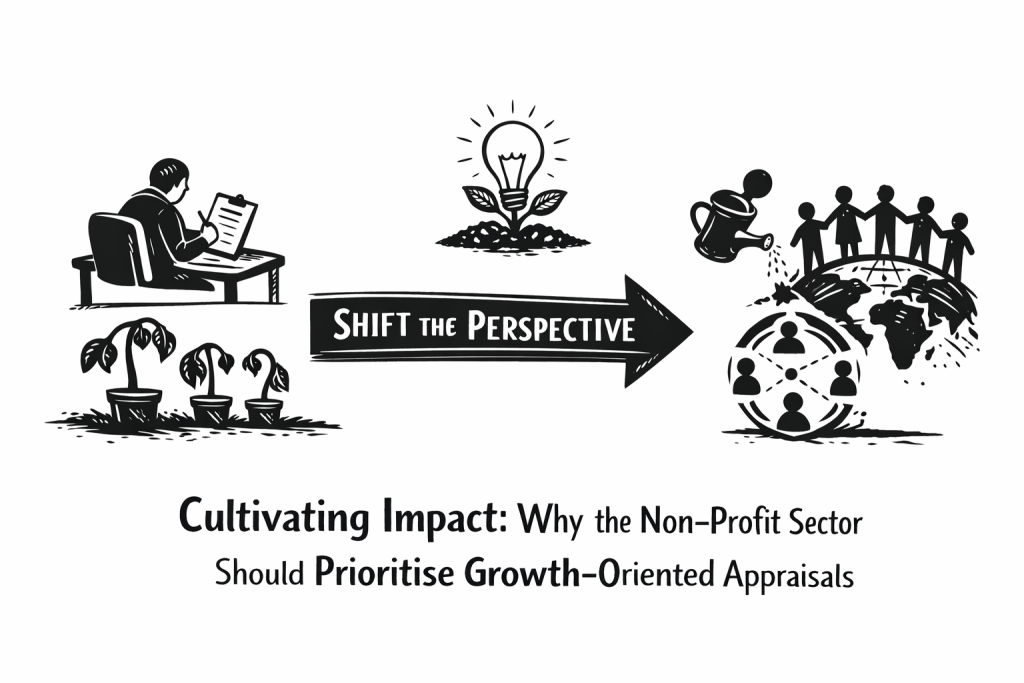
The Trap of Looking Backwards
Traditional performance appraisal is inherently retrospective. It examines past behaviour, outputs, and achievements, often through a narrow lens. While such reflection has value, it does not necessarily predict future effectiveness, especially in complex and evolving environments.
The challenge becomes clear when individuals move into new roles. A strong programme officer may not automatically become a strong manager. The skills required are fundamentally different. Technical excellence does not always translate into leadership capacity. In the non-profit sector, where roles are fluid and organisations frequently respond to emerging crises, this mismatch can be particularly damaging.
Many organisations unknowingly promote staff based on past success in technical roles, only to discover that these individuals struggle to manage teams, navigate partnerships, or make strategic decisions. The cost is high. Teams become demotivated, programmes weaken, and the organisation’s mission suffers.
Growth-oriented appraisal systems avoid this trap. They deliberately separate the evaluation of past performance from the assessment of future potential. This distinction allows organisations to identify leadership capacity, adaptability, emotional intelligence, and learning agility. These are the qualities that matter most in uncertain contexts.
Growth as a Source of Motivation
Unlike the private sector, many non-profits cannot rely heavily on financial incentives to retain talent. Salaries are often constrained by donor conditions and public expectations. As a result, staff motivation must come from other sources.
Professional growth is one of the most powerful. When individuals feel that an organisation is investing in their future, their sense of belonging, commitment, and ownership increases. They do not simply complete tasks. They begin to see themselves as partners in a shared mission.
A growth-oriented appraisal transforms the annual review into a forward-looking conversation. Instead of asking, “How did you perform last year?”, it asks, “What do you need to grow this year?”
This shift changes organisational culture. Staff feel valued, not judged. Managers become coaches, not inspectors. The appraisal process becomes a structured space for reflection, aspiration, and planning.
Linking Appraisal to Training and Development
One of the most strategic advantages of a growth-oriented approach is its direct link to training and development. Many non-profit organisations invest in training without clear alignment to individual or organisational needs. Workshops are attended, certificates are earned, but impact remains unclear.
Growth-oriented appraisals address this gap. They identify specific development needs based on both current performance and future aspirations. These needs may include technical skills such as proposal writing, monitoring and evaluation, or digital communication. They may also involve leadership capabilities such as strategic thinking, negotiation, and partnership management.
The result is a more intentional and cost-effective learning strategy. Training becomes targeted rather than generic. Career planning becomes structured rather than accidental.
Most importantly, organisations build a pipeline of capable leaders. When vacancies arise, internal candidates are prepared. Succession becomes smoother, reducing disruption and protecting institutional memory. This is particularly important in contexts where leadership transitions can weaken organisations.
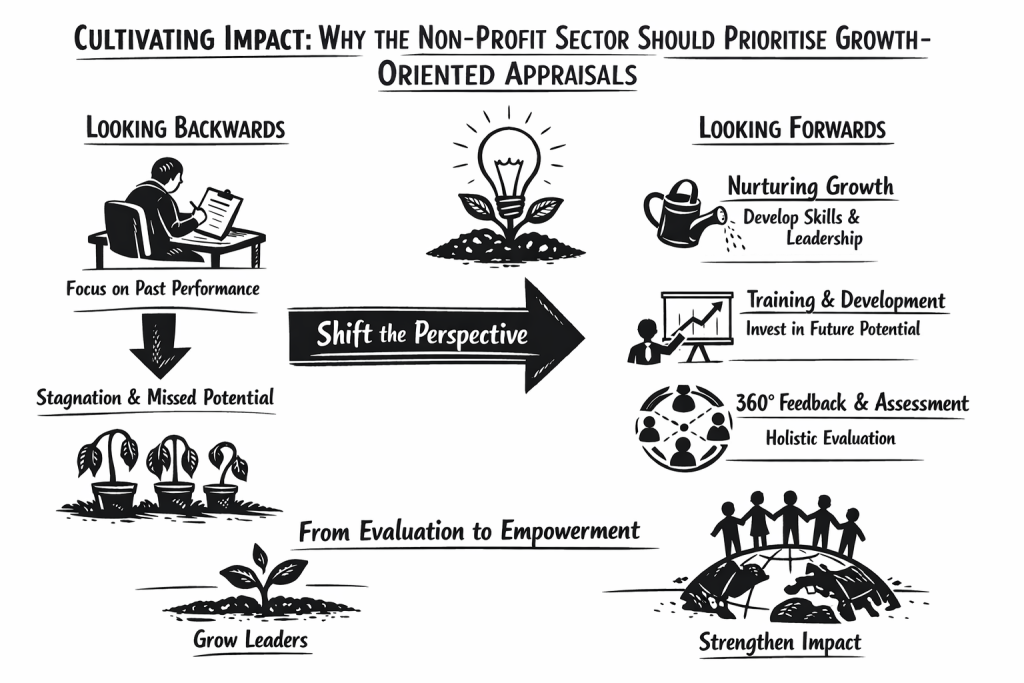
Modern Methods for a Holistic Perspective
To support this shift, non-profits are increasingly adopting modern appraisal methods that provide a broader and more balanced understanding of performance and potential.
360-degree feedback is one such approach. Instead of relying solely on a supervisor’s judgement, this method gathers insights from colleagues, partners, and sometimes even beneficiaries. In the collaborative and relationship-driven environment of non-profit work, this wider perspective is invaluable. It highlights interpersonal skills, teamwork, and communication, which are often more important than technical expertise.
Assessment centres offer another forward-looking tool. Through simulations, role-play, and real-world problem-solving exercises, organisations can observe how individuals respond to complexity, pressure, and ambiguity. These exercises help predict future leadership performance more effectively than past reports alone.
Self-evaluation also plays a crucial role. When staff reflect on their own strengths, weaknesses, and aspirations, the appraisal becomes a dialogue rather than a judgement. This negotiated approach strengthens trust and encourages ownership of personal development.
Together, these methods create a richer, more nuanced understanding of each individual. They help organisations move from a culture of compliance to a culture of growth.
Guarding Against Bias and Subjectivity
Traditional appraisal systems are often undermined by unconscious bias. Managers may be influenced by recent events, personal preferences, or general impressions rather than objective evidence.
Common errors include the “halo effect”, where a generally positive impression overshadows specific weaknesses, and the “recency effect”, where recent performance is given disproportionate weight. Such distortions can lead to unfair evaluations, missed talent, and damaged morale.
Growth-oriented systems mitigate these risks. Multiple data sources, structured criteria, and long-term developmental perspectives provide greater objectivity. They encourage managers to base decisions on patterns rather than isolated incidents.
This strengthens organisational fairness and professionalism. Staff perceive the system as credible. Trust in leadership increases. Diversity and inclusion also improve, as hidden talent is more likely to be recognised.
A Strategic Imperative for the Future
The shift towards growth-oriented appraisal is not simply a human resource reform. It is a strategic imperative. The non-profit sector faces increasing complexity, shrinking funding, and rising expectations from communities and donors. Organisations must be agile, innovative, and resilient.
People are the most important asset in achieving this. Yet many organisations continue to manage talent in ways that limit potential rather than unlock it.
A growth-oriented system aligns individual development with organisational strategy. It strengthens leadership pipelines, enhances motivation, and improves programme quality. It also supports organisational sustainability by ensuring that knowledge, skills, and leadership are continuously renewed.
Conclusion
The future of the non-profit sector will depend not only on strong missions, but on strong people. Performance appraisal, when narrowly focused on past results, cannot meet this challenge.
A growth-oriented approach offers a more powerful alternative. It recognises that impact is not only about what individuals have achieved, but about what they are capable of becoming.
Organisations that cultivate this mindset will be better positioned to navigate uncertainty, strengthen partnerships, and deliver meaningful change. In doing so, they will not only transform their workforce. They will transform their impact on society.