
Sometimes, a career-changing opportunity begins with something as simple as taking notes in a meeting room.
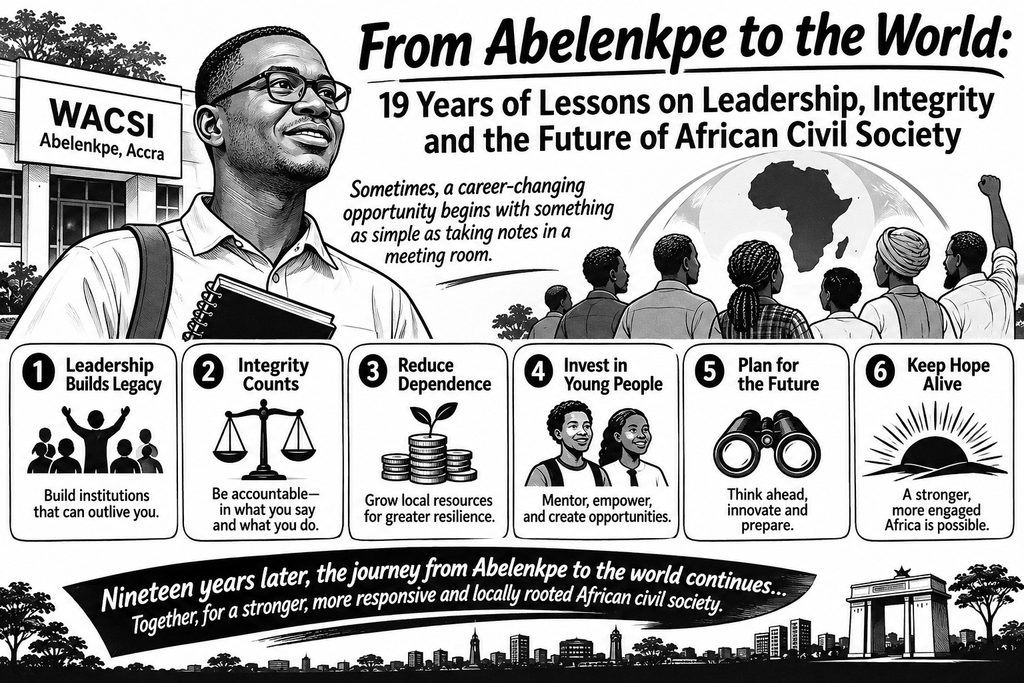
In November 2007, I walked into the offices of the West Africa Civil Society Institute (WACSI) in Abelenkpe, Accra, with a notebook, a recently completed master’s degree and a strong desire to contribute to the development sector.
I had just completed a Master’s degree in Development Management at the Ghana Institute of Management and Public Administration (GIMPA). After volunteering with two international NGOs and a community-based organisation, I was looking for an opportunity to learn and grow.
I joined WACSI as Volunteer 001 and was assigned as rapporteur for an NGO Management Training for Civic Leaders in West Africa.
There is an interesting historical connection here. WACSI had been established in 2005 and became operational in July 2007, just months before I walked through its doors.
I was joining an institution that was itself beginning its journey.
As I listened to civil society leaders from across West Africa, I noticed two things. There was enormous passion for social change, but many organisations were struggling with weak governance, limited funding, leadership challenges and dependence on external donors.
Nineteen years later, those conversations still influence how I think about civil society development.
Today, I serve as Head of the Capacity Development Unit at WACSI. My work has taken me into regional and global conversations on leadership, organisational development, civic space and the future of international development. I have also contributed to initiatives such as Reimagining INGOs (RINGO), Innovation for Change (i4C)-Hub Afrique and the International Consortium on Closing Civic Space (iCon).
Looking back, I realise that the most important lessons have not always come from formal training programmes or leadership positions. Many have come from observing people, working with organisations, making mistakes and learning what it takes to build institutions that last.
Here are six lessons that have stayed with me.
1. Leadership is about building something that can outlive you
One of the challenges I noticed early in my career was the dependence of many NGOs on their founders.
Some founders were visionary and deeply committed. However, they often controlled almost everything, from fundraising and decision-making to staff management.
The problem was simple: when the founder was absent, the organisation struggled.
Over the years, I have come to understand that leadership is not about how much power you hold. It is about how much capacity you build in others.
An organisation should not become the personal property of its Executive Director or founder. Leaders are custodians of an institution’s mission and public trust.
This connects with the African philosophy of Ubuntu: I am because we are.
Good leadership requires listening, sharing responsibility, trusting people and creating opportunities for others to grow.
My biggest lesson? Do not build an organisation that cannot function without you. Build one that becomes stronger because of the people you develop.
2. We cannot demand accountability from others while avoiding it ourselves
Civil society organisations regularly call on governments and public institutions to be transparent, accountable and ethical.
But how often do we examine our own practices?
An organisation can be legally registered and still have serious ethical problems. It can promote good governance externally while practising poor governance internally.
I have seen how issues such as unfair recruitment, conflicts of interest, poor financial management and decisions made without staff or community participation can undermine organisational credibility.
Ethics must go beyond having policies on paper. It must be reflected in how we treat people, manage resources and make decisions.
We cannot claim to empower communities while making decisions on their behalf.
For me, integrity is not what an organisation says about itself. It is what people experience when they work with it.
3. African civil society must reduce its dependence on external funding
I remember the anxiety that followed whenever donor funding was delayed or withdrawn. For organisations that depended on one or two major donors, such developments could threaten their very survival.
Unfortunately, financial dependence can also influence organisational priorities. Sometimes, organisations pursue funding opportunities that have little connection with their original missions.
This is why I have become increasingly interested in domestic resource mobilisation and the #ShiftThePower movement.
Africa has a strong tradition of community giving and mutual support. In Ghana, practices such as Adɔyɛ remind us that generosity and community support are not foreign concepts.
We must do more to build on these traditions.
African civil society organisations should invest in local philanthropy, individual giving, partnerships with local businesses, social enterprises and other sustainable sources of income.
The goal is not to reject international funding. It is to build organisations that have enough financial resilience to make independent decisions.
A financially sustainable organisation is better positioned to protect its mission, defend its values and remain accountable to the people it serves.
4. Never underestimate the power of investing in young people
My own story is a reminder of what can happen when someone gives a young professional an opportunity.
I started with a volunteer assignment. I was given space to learn, observe and contribute. That experience helped shape my professional journey.
Interestingly, WACSI introduced its Next Generation Internship Programme (NGIP) in January 2008, shortly after my own journey began.
The programme provides young West Africans with six months of practical experience in civil society work, including capacity development, advocacy, knowledge management and organisational management.
I believe this is one of the most important investments an institution can make.
Young people do not become leaders simply because we invite them to conferences or give them opportunities to speak. They need practical experience, mentorship, networks and real responsibilities.
We must also move beyond treating young people as the leaders of tomorrow. They have ideas, skills and contributions that are needed today.
The real test of mentorship is not how many young people attend your programmes. It is how many become confident professionals and leaders capable of making a difference.
5. Civil society must prepare for the future, not just respond to crises
For many years, civil society organisations have operated in firefighting mode.
A donor withdraws funding. A government introduces restrictive policies. Civic space shrinks. An organisation loses a key partner. Everyone gathers to find an immediate solution.
But what happens when we spend so much time responding to today’s problems that we have no time to prepare for tomorrow?
The urgency of this question is clear. CIVICUS’s 2025 findings reported that 44 out of 50 countries and territories in sub-Saharan Africa had obstructed, repressed or closed civic space.
This is not just a statistic. It represents the difficult environment in which many civil society organisations, journalists, activists and human rights defenders are working.
In September 2025, I wrote From Crisis to Creation: Futures Thinking for African CSOs, exploring how organisations can move beyond constant firefighting.
My argument was that even organisations with limited resources can begin thinking differently about the future.
We need to ask:
- What will civil society look like in five or ten years?
- How will artificial intelligence change our work?
- What happens if traditional donor funding continues to decline?
- How do we protect civic participation in increasingly restrictive environments?
- What kind of organisations do we want to leave for the next generation?
Futures thinking is not about predicting everything that will happen. It is about preparing for different possibilities and making better decisions today.
Innovation does not always require expensive technology. Sometimes, it begins with the courage to question old practices and try something different.
6. Despite the challenges, there is still reason to hope
It is easy to become discouraged when we look at the challenges facing African civil society.
However, there is another side to the story.
Afrobarometer’s 2026 findings show that 64% of citizens surveyed across 38 African countries support the right to join organisations of their choice.
This tells us something important: the desire for participation, association and civic engagement remains strong.
People still want to contribute to decisions that affect their lives. Communities still want to organise, speak up and influence their future.
Our responsibility as civil society actors is to ensure that organisations remain capable, trusted and relevant enough to respond to these aspirations.
We must strengthen our institutions, protect civic space and build relationships with the communities whose interests we represent.
There is still much work to do, but there is also much worth protecting.
Nineteen years later: What remains important?
When I think about the young graduate who walked into WACSI’s office in Abelenkpe in November 2007, I am filled with gratitude.
I have learned from colleagues, mentors, community leaders, young professionals and organisations across the region. I have also learned that experience alone does not make us better leaders. We must remain willing to learn, question ourselves and adapt.
To young professionals starting their journey today, my advice is simple: take every opportunity seriously. Be curious, work hard, develop your skills and build a reputation for integrity. Never underestimate a humble beginning.
To established leaders, share power, mentor others and build institutions that can outlive your tenure.
And to African civil society as a whole, we must become more locally rooted, financially resilient, ethically grounded and better prepared for the future.
In November 2007, I arrived at WACSI with a notebook and a desire to contribute. Nineteen years later, that desire remains.
I am reminded that the real measure of a professional journey is not simply the positions we occupy, the programmes we lead or the recognition we receive. It is also the people we influence, the institutions we strengthen and the opportunities we create for others.
The journey from Abelenkpe to the world continues. And the work of building a stronger African civil society is far from finished.