
What if African non-profits did not have to look only to Western corporate governance models to understand what a good board should be?
Across Africa, many non-profit organisations operate with governance structures that have been heavily influenced by Anglo-American corporate practice. Board meetings are organised around agendas, minutes, financial reports, compliance, voting and performance indicators.
These practices have value. They provide structure, accountability and legal clarity.
But they do not always answer a deeper question:
What does good governance look like in an African organisation, rooted in African relationships, values and ways of making decisions?
Perhaps part of the answer can be found in institutions that existed long before the modern non-profit organisation.
In Ghana, the Akan system of family governance offers an interesting place to start.
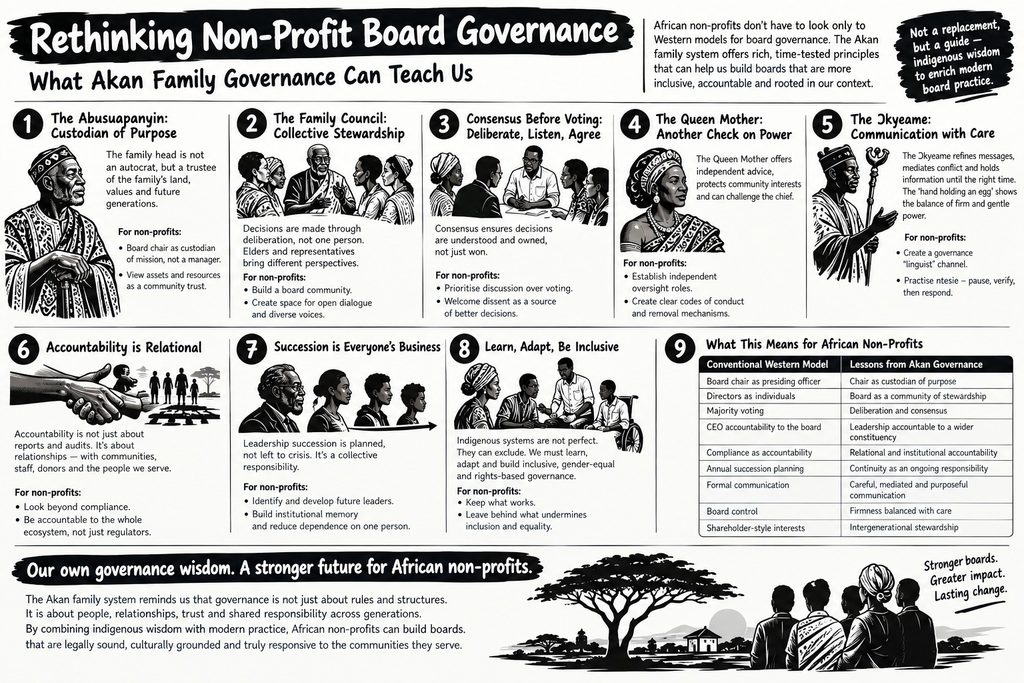
The Akan family, or abusua, was not simply a social unit. It was also an important governance institution. The Abusuapanyin, the family head worked with elders and representatives of family branches to deal with matters affecting the family. Research on Akan family governance describes the Abusuapanyin and elders as responsible for family welfare, property and important collective decisions.
This does not mean that a non-profit should simply copy the traditional family system.
Rather, it invites us to ask:
What governance wisdom is already present in African societies that could help us rethink the modern non-profit board?
1. The Abusuapanyin: from board chair to custodian
The first lesson comes from the role of the Abusuapanyin, the head of the family.
It is tempting to compare the Abusuapanyin directly with a board chair. The comparison is useful, but only up to a point.
The more interesting connection is the idea of custodianship.
The family head is not simply there to exercise personal power. The office carries responsibility for the welfare and continuity of the wider family. Family property and interests are held within a much longer intergenerational story. Evidence on Akan family governance shows the Abusuapanyin taking responsibility for family matters and property while working with other family representatives.
This has an important lesson for non-profit boards.
A board chair should not think:
“This is my organisation.”
The better question is:
“What am I holding in trust, and for whom?”
The organisation’s money, reputation, knowledge, relationships, staff and assets are not personal possessions. They exist for a purpose.
A board chair therefore becomes less of a corporate commander and more of a guardian of purpose.
This is particularly important for founder-led organisations, where the founder can sometimes become confused with the institution itself.
The Akan example reminds us that leadership is an office carried on behalf of something larger than the individual.
2. The family council: governance should not sit with one person
The Abusuapanyin does not operate in isolation.
Akan family governance includes elders and representatives of different branches of the family. These structures provide advice, deliberation and collective responsibility. Research describes family governance as involving the Abusuapanyin, elders and other family representatives, with meetings and consultations used to address family matters.
There is an important lesson here for non-profit boards.
A board should be more than a collection of individual directors.
It should function as a community of stewardship.
Too often, board meetings become a series of presentations:
The Executie Director reports.
The finance team presents.
The board asks a few questions.
A resolution is proposed.
Everyone votes.
Meeting closed.
But governance should be more than receiving information.
Boards need space to think together.
This means asking questions such as:
- What are we seeing that management may not see?
- What are communities telling us?
- What are we learning?
- Where might our strategy be drifting?
- Whose voice is missing?
- What risks are we not discussing?
- What will this decision mean five years from now?
The lesson from the family system is simple:
Governance is collective stewardship, not simply oversight.
3. Consensus before voting
Another powerful lesson is the importance of deliberation.
Akan governance has often been discussed in relation to consensus-based decision-making. Scholars such as Kwasi Wiredu have explored consensus as an important feature of African political thought, although scholars have also debated how democratic traditional governance actually was.
The lesson for non-profits is not that boards should never vote.
Voting is sometimes necessary.
The lesson is that voting should not become a substitute for thinking together.
A board can technically make a decision with a majority while leaving half of the board unconvinced.
That may be legal.
But it may not be good governance.
A stronger practice is:
deliberate → listen → challenge → clarify → seek common ground → decide.
The board can still vote when necessary.
But the goal should be a decision that people understand and can collectively carry, rather than simply a 51–49 victory.
4. The Queen Mother: governance needs another source of authority
One of the most interesting features of Akan governance is the role of the Queen Mother.
Her role varies across Akan societies, so we should avoid treating it as one uniform institution. However, research shows that queen mothers can play important roles in succession, advice, social welfare and dispute resolution. The Asantehemaa’s court, for example, has been studied as a forum for resolving disputes.
For non-profits, the broader lesson is about countervailing authority.
Boards need people who can ask uncomfortable questions.
Who challenges the chair?
Who challenges the founder?
Who speaks when the Executive Director becomes too powerful?
Who asks whether the organisation is still serving the people it was created to serve?
This could be an independent director, governance committee, community representative, safeguarding lead or another trusted accountability mechanism.
The principle is:
Good governance needs more than one centre of authority.
5. The Ɔkyeame: the importance of how we communicate
The Ɔkyeame, or linguist, offers another fascinating lesson.
The linguist is not simply a translator. The institution has historically carried responsibilities around communication, representation and the careful transmission of messages.
This can be valuable for non-profit boards.
Many governance problems are not caused by the absence of policies.
They are caused by poor communication.
A board chair speaks too quickly.
An Executive Director reacts defensively.
A director sends an angry email.
A disagreement becomes personal.
Before long, a governance issue has become a relationship crisis.
The lesson is to create space for careful communication and mediation.
The symbol of a hand holding an egg is particularly powerful in Akan visual culture, power has to be held neither too tightly nor too loosely. Research on Akan linguist-staff symbolism documents the egg as representing the fragility of power.
This is an excellent metaphor for boards.
Hold power too tightly and you crush trust.
Hold it too loosely and you lose accountability.
Good governance requires both firmness and care.
6. Accountability is relational
Modern governance often reduces accountability to documents.
Audits.
Policies.
Reports.
Minutes.
Declarations.
These are important.
But accountability is also relational.
Who can question the board?
Who can tell the organisation when it is getting something wrong?
Does the board listen to staff?
Does it listen to communities?
Does it take complaints seriously?
Does it explain difficult decisions?
The Akan family system offers a different starting point, accountability is connected to belonging and responsibility to others.
For a non-profit, this means thinking about accountability not only upwards to regulators and donors, but also downwards and outwards to communities, staff, members and the people whose lives the organisation exists to serve.
7. Succession is everyone’s business
Another lesson is succession.
In many African organisations, succession planning becomes urgent only when the founder wants to leave, the Executive Director resigns or a crisis occurs.
That is too late.
Traditional governance systems have long had processes for leadership succession, involving family branches, elders and other authorities. The exact arrangements differ across Akan communities, but succession is understood as a collective matter rather than simply an individual’s decision.
Non-profit boards could learn from this.
Succession should be discussed before there is a vacancy.
Boards should regularly ask:
- Who could lead this organisation in five years?
- What leadership capabilities are we developing?
- Are we creating opportunities for younger leaders?
- Is the organisation too dependent on one person?
- What institutional knowledge needs to be transferred?
A healthy organisation should be able to outlive its founder.
8. But we must not romanticise tradition
There is an important caution.
Indigenous systems should not be treated as perfect simply because they are indigenous.
Some customary governance structures have historically excluded women and other groups from decision-making. Research on Akan customary systems has documented gender inequalities in authority over family property and inheritance.
This matters.
The goal is therefore not to say:
“Traditional governance is better than Western governance.”
That would simply replace one form of uncritical thinking with another.
The better question is:
What can we learn, what should we adapt, and what should we leave behind?
We can draw on the strengths of indigenous governance, stewardship, collective responsibility, deliberation, relational accountability and continuity while deliberately building modern non-profit governance around inclusion, gender equality, human rights, safeguarding and transparency.
9. Towards an African non-profit governance model
This suggests a different way of thinking about the board.
Instead of asking only:
“Does our board meet good corporate governance standards?”
we could also ask:
“Does our governance reflect the values and relationships that make our organisation legitimate in its context?”
A more African-rooted board might therefore see itself as:
| Conventional emphasis | Indigenous governance lesson |
| Board chair as presiding officer | Chair as custodian of purpose |
| Directors as individuals | Board as a community of stewardship |
| Majority voting | Deliberation and consensus before voting |
| Executive Director accountability to the board | Leadership accountable to a wider constituency |
| Compliance as accountability | Relational and institutional accountability |
| Annual succession planning | Continuity as an ongoing responsibility |
| Formal communication | Careful, mediated and purposeful communication |
| Board control | Firmness balanced with care |
| Shareholder-style interests | Intergenerational stewardship |
This is not about abandoning modern governance.
Indeed, Ghana’s current governance architecture already creates space for locally relevant thinking. The National Corporate Governance Code was developed partly to reflect Ghanaian cultural dispositions and national aspirations and explicitly recognised the need to address sectors including not-for-profit organisations.
For Ghanaian NPOs, however, legal compliance remains essential. Organisations must operate within the applicable Companies Act and NPO regulatory requirements. The indigenous governance principles discussed here should therefore inform how boards behave and exercise their responsibilities, not replace their legal duties.
The bigger question
Perhaps the deeper issue is not whether African non-profits should have boards.
It is whether our boards are fit for the organisations and societies they are meant to serve.
We have spent years importing organisational structures, governance manuals, strategic planning tools and board templates.
Perhaps it is time to also look inward.
Our ancestors developed systems for managing shared resources, resolving disputes, selecting leaders, protecting collective interests and maintaining continuity.
They were not perfect.
But they contain ideas worth revisiting.
The Abusuapanyin reminds us that leadership is stewardship.
The family council reminds us that governance is collective.
The Queen Mother reminds us that power needs another source of authority to question it.
The Ɔkyeame reminds us that how we communicate matters.
Consensus reminds us that disagreement does not have to produce permanent division.
And the hand holding the egg reminds us that power must be held with both firmness and care.
For African non-profits, perhaps the future of governance is not about choosing between “traditional” and “modern”.
It is about creating governance systems that are legally sound, professionally accountable, culturally grounded and genuinely responsive to the people and communities they exist to serve.
That may be the beginning of a more African approach to non-profit governance.