
What #ShiftThePower Means to Me
Eshban Kwesiga’s recent article, “#ShiftThePower was never about sharing the pie, it’s about baking a new pie,” prompted me to reflect on what we really mean when we talk about shifting power.
I strongly connect with the argument that this conversation cannot simply be about giving local organisations a larger slice of an existing funding pie. If the same actors continue to decide what matters, who receives resources, what counts as evidence and what success looks like, then we may have changed the distribution of resources without changing the system itself.
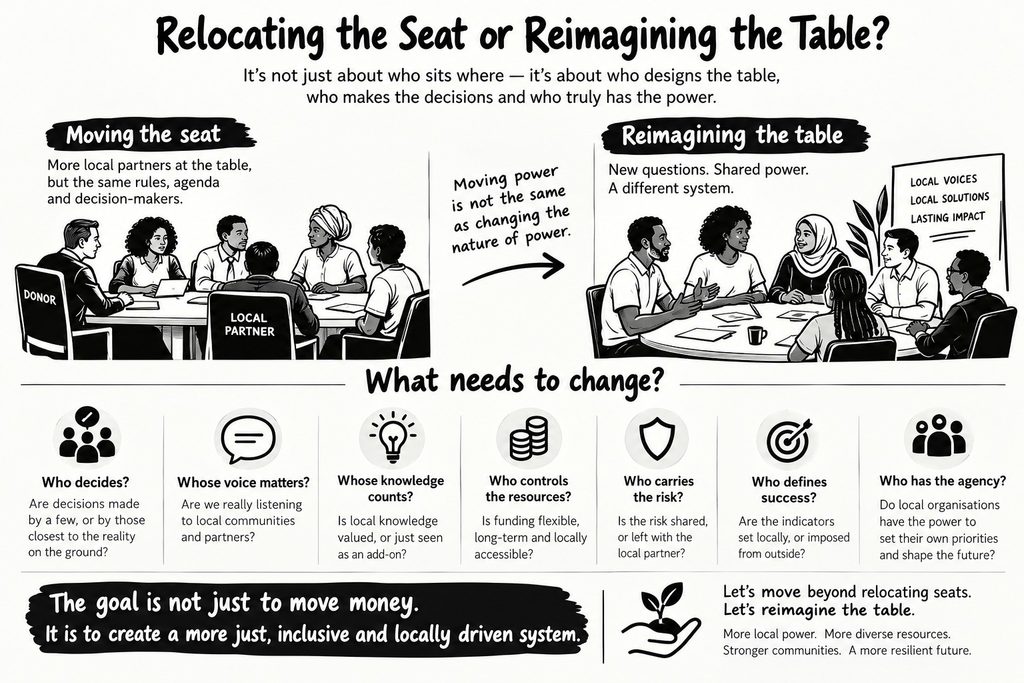
For me, this points to an important distinction, moving power is not the same as changing the nature of power.
Moving the seat does not necessarily change the table
Moving power is about who controls resources, who makes decisions, who sits at the table and who implements programmes. This matters.
For example, an international NGO may decide to transfer a larger proportion of a project budget to a local civil society organisation. That is a positive step. A local organisation may also be invited to sit on a global advisory committee or participate in an international conference.
But we should ask what happens next.
Who designed the programme?
Who determined the budget?
Who defined the indicators?
Who decided what risks were acceptable?
Who owns the data?
Who has the final say when priorities change?
If the local organisation receives more money but still has to implement a programme designed elsewhere, report against indicators it did not develop and seek approval for significant changes, then power has moved only partially.
The seat has moved, but the table has not changed.
Changing the nature of power goes deeper
Changing the nature of power requires us to ask different questions, How are decisions made? Whose voice matters? Whose knowledge is valued? Who carries the risk? Who defines success? Who is accountable to communities?
These questions take us beyond localisation as a technical or administrative exercise.
Consider a community organisation working on youth employment. A conventional funding model may begin with a donor-defined priority, followed by a call for proposals. The local organisation then develops a proposal designed to fit that priority.
A different approach would begin with the organisation and community defining the problem themselves, deciding what intervention makes sense, determining what success should look like and then working with funders to resource that vision.
The difference may appear small on paper, but the power relationship is fundamentally different.
In the first model, the organisation responds to an agenda.
In the second, it helps shape the agenda.
That is the shift we should be pursuing.
The question of money
This is where Eshban’s idea of “baking a new pie” becomes particularly important.
For many civil society organisations in Africa, international funding remains an important source of institutional survival. Over time, however, this can create a dangerous dependency.
Organisations become highly skilled at writing proposals, responding to calls, meeting compliance requirements and adapting their language to donor priorities. Yet these skills do not necessarily translate into greater financial independence.
This is why local resource mobilisation matters.
Community philanthropy, local giving, private-sector partnerships, membership contributions, diaspora giving, crowdfunding, social enterprise and other locally rooted resources can help organisations build greater agency.
But I would add an important caution, local money is not automatically more democratic money.
Moving resources from international donors to local elites, corporations or politically connected actors does not necessarily change the character of power.
The goal is therefore not simply to move money from the North to the South.
The goal is to create more diverse, accountable and locally rooted resource ecosystems in which communities and civil society have greater choices.
Who carries the risk?
One of the clearest tests of whether power has really shifted is risk.
Too often, international funders and intermediaries retain significant decision-making authority while local organisations carry much of the operational risk.
The local organisation is expected to deliver in difficult environments, maintain relationships with communities, respond to crises and meet tight reporting requirements, while having limited access to flexible funding or institutional reserves.
When something goes wrong, the risk is often felt most immediately by the organisation closest to the community.
Changing the nature of power therefore requires more than direct funding. It requires shared risk.
This could mean longer-term funding, realistic overheads, institutional strengthening, greater flexibility and genuine trust in local judgement.
Whose knowledge counts?
There is another dimension that is often overlooked: knowledge.
A local organisation may have worked in a community for seventeen years. It may understand local politics, relationships, language, history and social dynamics in ways that an external consultant visiting for three weeks cannot.
Yet formal systems can still privilege the consultant’s report over the community organisation’s lived knowledge because one is seen as “technical” and the other as “local”.
This is not simply a capacity issue. It is also a question of whose knowledge we consider legitimate.
Changing power means recognising that local knowledge is not an anecdote to be added to a technical analysis. It can be the starting point for understanding the problem.
From participation to agency
This is also why I am cautious when we celebrate participation without examining what that participation actually means.
An organisation can attend ten international meetings and still have very little influence.
A community representative can speak at a conference and still have no say over the resources being discussed.
A local partner can be listed as a co-implementer while the strategic decisions remain elsewhere.
Participation is important, but agency is deeper than participation.
Agency means having the ability and resources to make choices, act on them and accept responsibility for the outcomes.
That is the kind of power shift that matters.
What role should international philanthropy play?
None of this means that international funders are no longer relevant.
Quite the opposite.
International philanthropy can play an important role in helping to build the conditions for greater local agency.
For example, a funder can provide flexible capital to help a local organisation build its fundraising systems, develop an institutional reserve, invest in leadership or test a new local resource mobilisation model.
In that case, international money is not simply financing another project. It is helping to build local power and long-term resilience.
The question is therefore not whether international money should disappear.
The question is whether international money can become catalytic rather than controlling.
Can it help create a system where local actors have more choices, more resources and more influence over time?
The real test of #ShiftThePower
For me, the real test is what happens when donor funding ends.
Can the organisation continue?
Can communities continue to organise?
Can local resources be mobilised?
Can civil society organisations set their own priorities?
Can they negotiate with external actors from a position of greater confidence and strength?
If the answer is no, then perhaps we have moved resources without sufficiently changing power.
Eshban’s call to “bake a new pie” therefore goes beyond fundraising. It challenges us to rethink the architecture of development itself.
For me, #ShiftThePower is not simply about who occupies the seat.
It is about who designed the table, who decides what is discussed, whose knowledge counts, who controls the resources, who carries the risk and who ultimately has the agency to shape the future.
That is the difference between moving power and transforming the nature of power.
And perhaps the work ahead is not simply to relocate seats around the existing table.
It is to have the courage to reimagine the table itself.