
For many years, international development has largely operated through a simple formula, money, expertise, and solutions flowed from the Global Mainority to the Global majority. Governments, civil society organisations, and communities in Africa often found themselves implementing programmes designed elsewhere and funded by external actors.
While this model has contributed to important progress in areas such as health, education, and poverty reduction, it has also created a difficult reality. Many countries and institutions have become dependent on external funding, external expertise, and external decision-making.
Today, that model is being increasingly questioned.
Across Africa and the wider Global Majority, there is growing recognition that sustainable development cannot be built on dependency. It must be built on agency, ownership, and sovereignty.
This is the context in which the Accra Reset has emerged.
A Response to a Changing World
Launched by Ghana’s President John Dramani Mahama and a coalition of global leaders, the Accra Reset seeks to reimagine how development, financing, and international cooperation work in a rapidly changing world. Rather than accepting the current architecture as inevitable, it asks a fundamental question:
What would development look like if countries had greater control over their own futures?
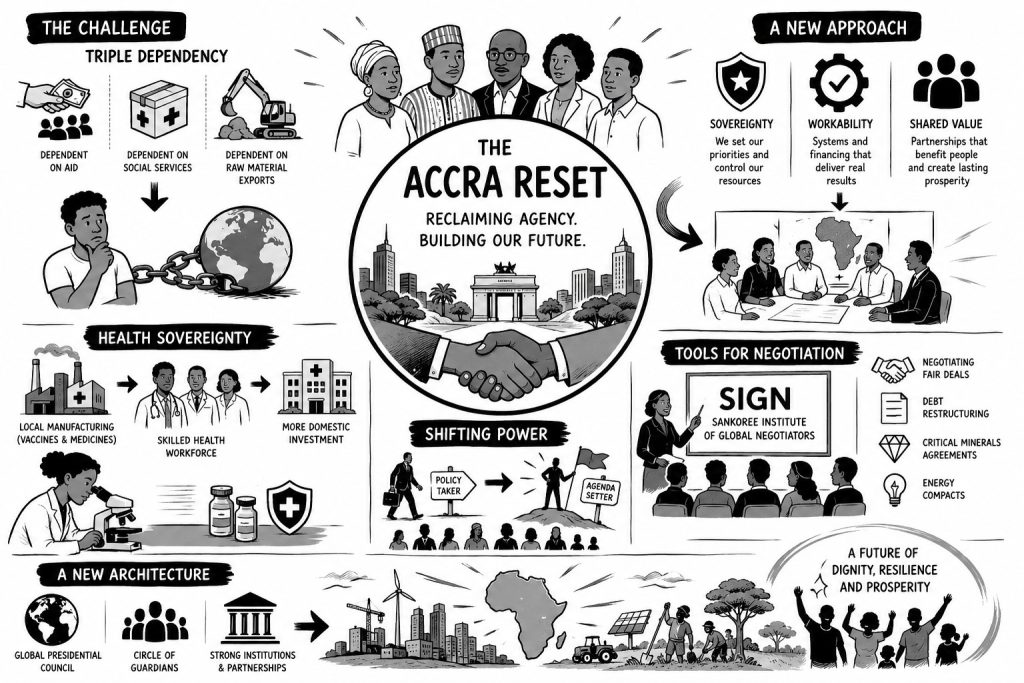
The initiative was unveiled at the United Nations General Assembly in 2025 and calls for a new development model built around three principles:
- Sovereignty
- Workability
- Shared Value
These principles may sound simple, but together they represent a significant departure from traditional aid thinking.
The Problem of Triple Dependency
At the heart of the Accra Reset is the recognition that many developing countries remain trapped in what has been described as a “triple dependency.”
First, countries often depend on external financing to fund essential public services.
Second, they rely heavily on imported products and technologies, including critical health supplies.
Third, many continue to export raw materials while importing higher-value finished products made from their own resources.
This creates a cycle where countries remain vulnerable to decisions made elsewhere.
When donor priorities shift, funding disappears.
When global supply chains break down, essential services are disrupted.
When commodity prices fluctuate, national economies suffer.
The Accra Reset argues that this model is no longer sustainable.
The Connection to Shifting Power
For those of us working within civil society and international development, the language of the Accra Reset feels familiar.
Over the past decade, conversations around localisation, decolonisation, and shifting power have become increasingly prominent.
Civil society organisations across Africa, Asia, Latin America, and the Middle East have repeatedly argued that communities closest to problems are often best positioned to design solutions.
The challenge has never been a lack of local knowledge.
The challenge has been a lack of trust.
Too often, power remains concentrated in institutions that control resources rather than those that understand local realities.
The Accra Reset extends this conversation beyond civil society and into global governance itself.
It asks whether countries should continue to be policy takers or whether they can become agenda setters.
It asks whether development priorities should continue to be externally driven or nationally determined.
Most importantly, it asks whether sovereignty can become the foundation of development rather than an afterthought.
In many ways, the Accra Reset is the political expression of what the Shift the Power movement has been advocating for years.
Moving Beyond Aid Dependency
One of the most powerful aspects of the Accra Reset is that it does not frame sovereignty as isolation.
This is not an argument against partnerships.
Nor is it an argument against international cooperation.
Instead, it is an argument for more balanced partnerships.
The initiative recognises that countries will continue to collaborate, trade, invest, and learn from one another. However, these relationships should be built on mutual respect and shared interests rather than dependency.
As global aid budgets shrink and geopolitical tensions increase, many countries are already confronting an uncomfortable reality, external funding cannot be the primary foundation of national development forever.
The future will require stronger domestic resource mobilisation, stronger institutions, stronger local industries, and stronger regional cooperation.
In short, resilience must be built from within.
Why Health Was Chosen First
Interestingly, the Accra Reset begins with health.
The initiative seeks to strengthen health sovereignty by supporting local manufacturing of vaccines, medicines, and medical supplies, while increasing domestic investment in health systems.
The choice of health is strategic.
The COVID-19 pandemic exposed how dependent many countries remain on external supply chains and international decision-making.
When vaccines became available, many African countries found themselves at the back of the queue.
The lesson was clear.
Without local capacity, sovereignty remains fragile.
Health therefore becomes a practical demonstration of a larger principle, countries must build the systems that allow them to manage their own futures.
Building Negotiation Power
One of the most innovative elements of the Accra Reset is the creation of SIGN—the Sankoree Institute of Global Negotiators.
This initiative recognises an often-overlooked reality.
Power is not only about resources.
Power is also about negotiation.
Whether discussing debt restructuring, climate finance, critical minerals, trade agreements, or investment deals, countries need leaders who can negotiate effectively and secure outcomes that serve their people.
SIGN aims to strengthen this capability by building a new generation of negotiators across the Global South.
This is perhaps one of the clearest examples of what shifting power looks like in practice.
It is not simply about receiving resources.
It is about strengthening the ability to shape the terms of engagement.
A Different Future Is Possible
The Accra Reset arrives at a time when the international development system is facing unprecedented questions.
Aid budgets are shrinking.
Trust in multilateral institutions is declining.
Geopolitical competition is intensifying.
At the same time, countries across the Global South are becoming increasingly assertive about defining their own priorities.
Against this backdrop, the Accra Reset offers an important reminder.
Development is not merely about funding projects.
It is about building capable institutions.
It is about strengthening sovereignty.
It is about creating systems that can endure beyond donor cycles and political transitions.
Most importantly, it is about restoring agency to those who have too often been positioned as recipients rather than leaders.
The conversation about shifting power is no longer confined to civil society conferences and development forums.
It is increasingly becoming a conversation about the future of global governance itself.
The Accra Reset may not have all the answers.
But it asks the right question:
What would happen if countries were trusted and empowered to lead their own development journeys?
That may ultimately be the most important development question of our time.